For over a century, a core dogma of biology held that bacteria were microscopic organisms incapable of exceeding a few tens of micrometers. The physical limits of cellular diffusion prevented nutrients and waste from traveling greater distances without an internal transport system. However, in the mangroves of the island of Guadeloupe, nature broke this rule with Thiomargarita magnifica, a bacterium that reaches up to two centimeters in length, making it perfectly visible to the naked eye.
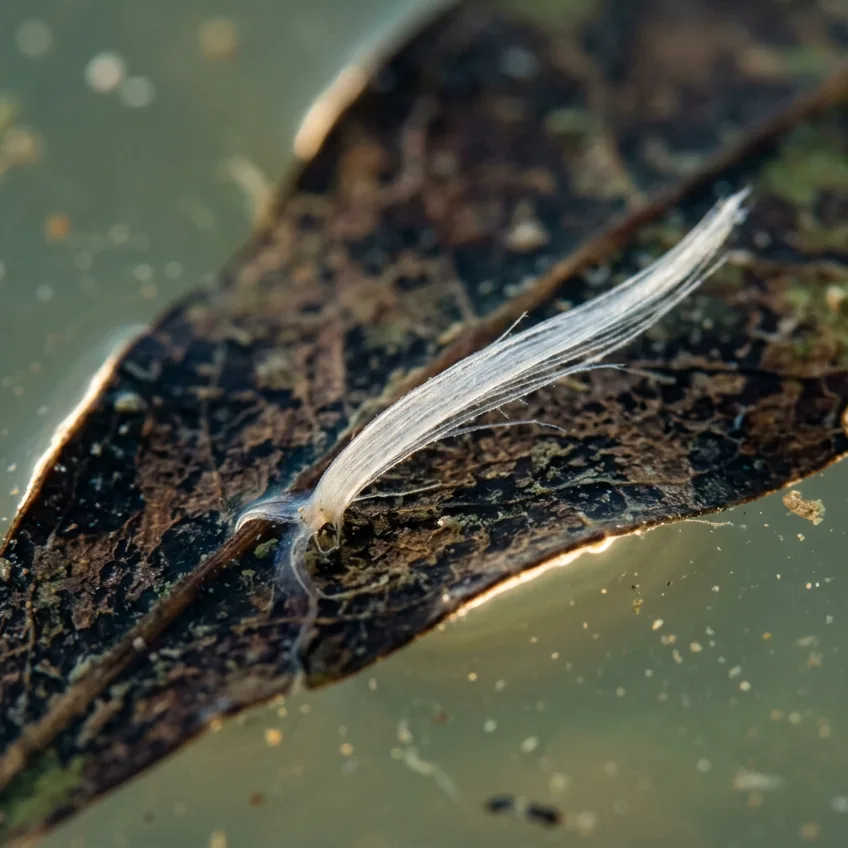
Discovered attached to submerged red mangrove leaves, this white, eyelash-shaped creature is larger than a housefly and about 5,000 times larger than an average bacterium such as Escherichia coli. For a human, the difference in scale would be equivalent to encountering another person as tall as Mount Everest.
Its astonishing size is made possible by unusual structural adaptations:
- A large central vacuole: Filled with water and metabolites, it pushes the active cellular cytoplasm against the outer membrane, reducing the distance nutrients must travel by diffusion.
- Membrane-bound structures called 'pepins': Unlike classic bacteria, whose DNA floats freely in the cytoplasm, this species packages its abundant genetic material and ribosomes inside membrane-bound sacs, a feature previously thought to be exclusive to complex eukaryotic cells.
- Colossal polyploidy: A single bacterial filament houses more than 700,000 complete copies of its genome distributed throughout its body.
Formally published in 2022 by the Lawrence Berkeley National Laboratory, this bacterium blurs the traditional boundary between simple microbes and complex multicellular organisms.
Source: Volland, J. M., et al. (2022). 'A centimeter-long bacterium with DNA compartmentalized in membrane-bound organelles'. Science, 376(6600), 1453-1458.