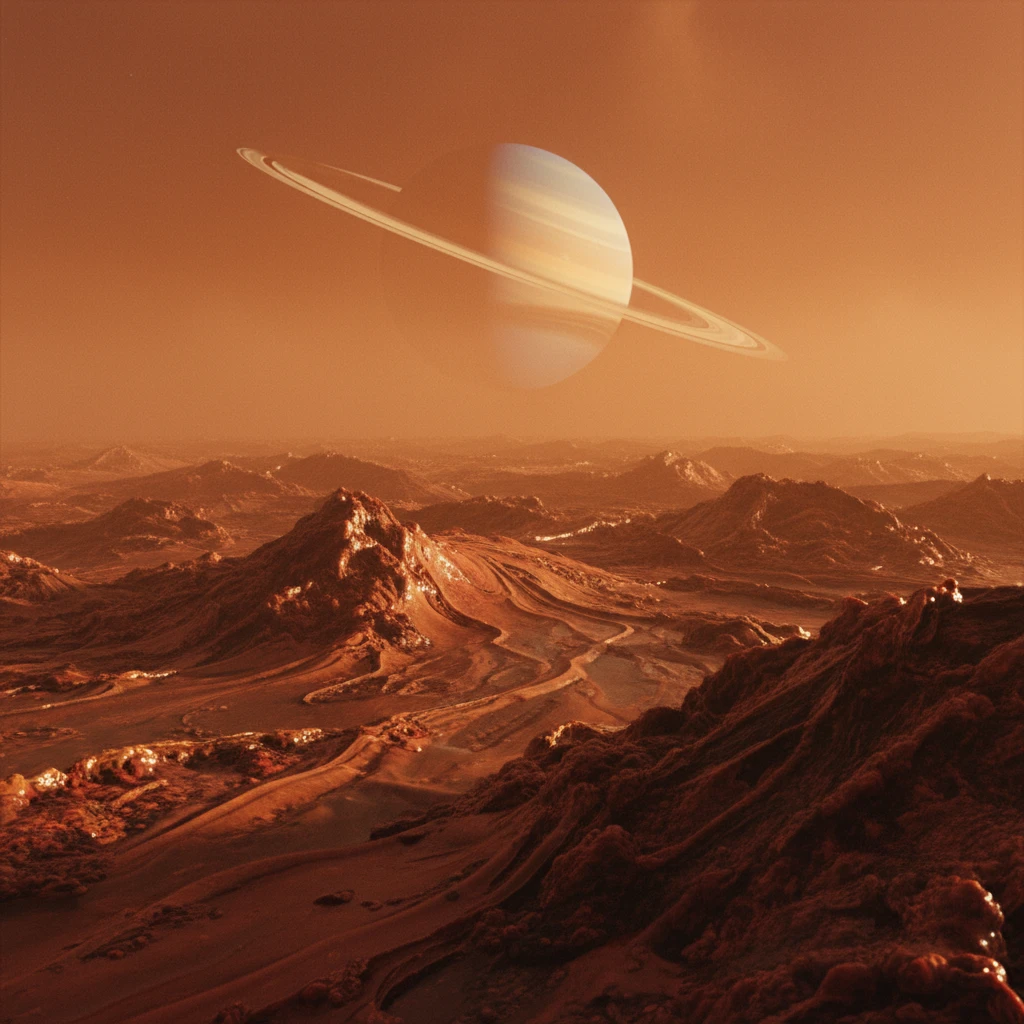
Beyond the icy surface of Titan, Saturn's largest moon, lies a fascinating chemical phenomenon that has captured the attention of astrobiologists: tholins. These are not simple rocks, but a complex mixture of organic compounds, mainly hydrocarbons and nitriles, that form when solar ultraviolet radiation or charged particles from space strike a mixture of gases such as methane and nitrogen.
The result is a polymeric, sticky, reddish-brown material that rains down onto Titan's surface, forming vast dunes and deposits. In fact, it is estimated that tholins could cover up to 40% of the surface of this moon. But their importance is not just geological. Scientists at the Massachusetts Institute of Technology (MIT) have discovered that, under experimental conditions simulating those on Titan, tholins can interact with liquid water (which might exist in the subsurface) to form complex molecules, including amino acids and nucleic acids – the fundamental building blocks of life as we know it.
This process suggests that tholin-covered worlds, such as Titan or even the dwarf planet Pluto, could have been, or might still be, a breeding ground for primitive life forms. NASA's upcoming Dragonfly mission, set to land on Titan in 2034, is specifically designed to study this complex chemistry and search for life precursors on this strange, distant world.
Source: NASA, Massachusetts Institute of Technology (MIT), Nature Astronomy journal