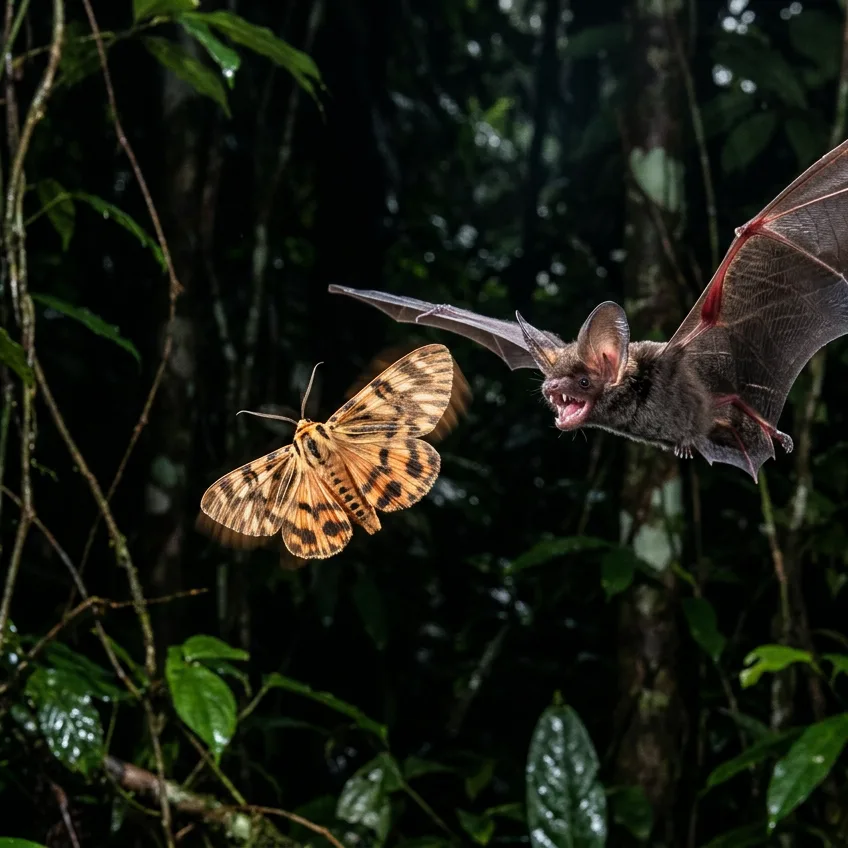
In the animal kingdom, the evolutionary arms race between bats and moths has reached levels of technological sophistication comparable to modern military aviation. While most nocturnal prey try to go unnoticed through sound-absorbing fur or erratic escape maneuvers, the small neotropical tiger moth Bertholdia trigona deploys an unparalleled defense: active acoustic jamming.
Using elastic organs located on the sides of its thorax called tymbals, this insect produces bursts of up to 4,500 ultrasonic microclicks per second as soon as it senses that a bat is initiating its final acoustic attack sequence. Although for decades researchers speculated that these sounds served as a toxicity warning or to startle the predator, a Wake Forest University study published in Science revealed the true nature of this biomechanical trick.
The moth's clicks act like a natural radar jammer: they saturate and confuse the bat's auditory cortex. By emitting pulses in the same frequency band and return intervals as the echoes the hunter expects to receive, the moth erases its exact spatial position and generates ghost echoes. As a result, the bat's capture success rate drops by more than 90%, cementing this small insect as the first documented animal capable of using acoustic electronic warfare to evade death.
Source: Science (Corcoran, Barber & Conner, 2009: 'Tiger Moth Jams Bat Sonar')