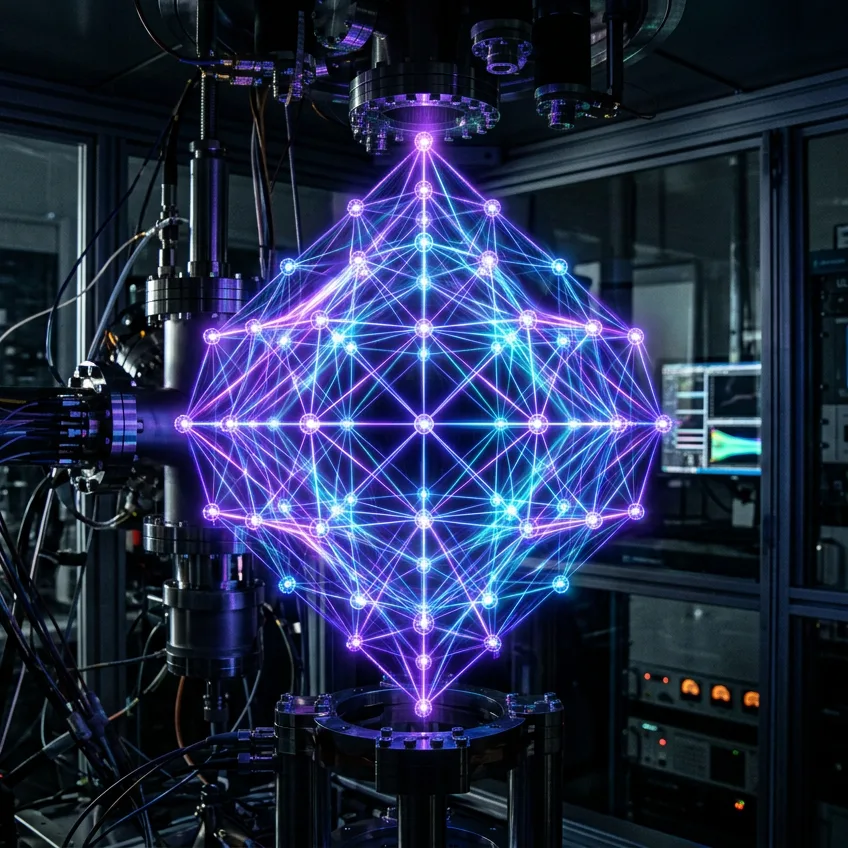
In classical physics, common crystals such as quartz, table salt, or diamond are defined by an atomic structure that repeats in an orderly and periodic way throughout three-dimensional space. However, in 2012, Nobel laureate in Physics Frank Wilczek formulated a puzzling hypothesis: could a crystal exist whose atomic structure repeats not in space, but in time?
The answer arrived five years later, when teams from the universities of Maryland and Harvard managed to synthesize the first discrete time crystals in a laboratory. These materials do not violate the laws of thermodynamics or constitute perpetual motion machines, since work cannot be extracted from them. Instead, they sit in their ground state of lowest possible energy, but their particles keep oscillating, changing orientation and periodically returning to their initial configuration without dissipating heat or requiring fuel.
The phenomenon is based on the spontaneous breaking of time-translation symmetry:
- Invariable frequency: Atoms respond to periodic stimuli by oscillating at twice the original period of the laser driving them.
- Resistance to disorder: Thanks to quantum localization, entangled particles avoid reaching thermal equilibrium, which would normally freeze the system.
- Quantum validation: In 2021, researchers from Google and several universities demonstrated their stability using the superconducting qubits of the Sycamore processor.
Beyond its conceptual beauty, this exotic state of matter opens the door to designing hyper-stable quantum memories and atomic clocks capable of measuring the universe with precision never achieved before.
Source: Nature (Zhang et al., 2017; Mi et al., 2021)