Imagine a place on Earth where life does not depend on the Sun. It seems unthinkable, but thousands of meters below the ocean surface, in perpetual darkness and under crushing pressures, entire ecosystems thrive thanks to an extraordinary process: chemosynthesis.
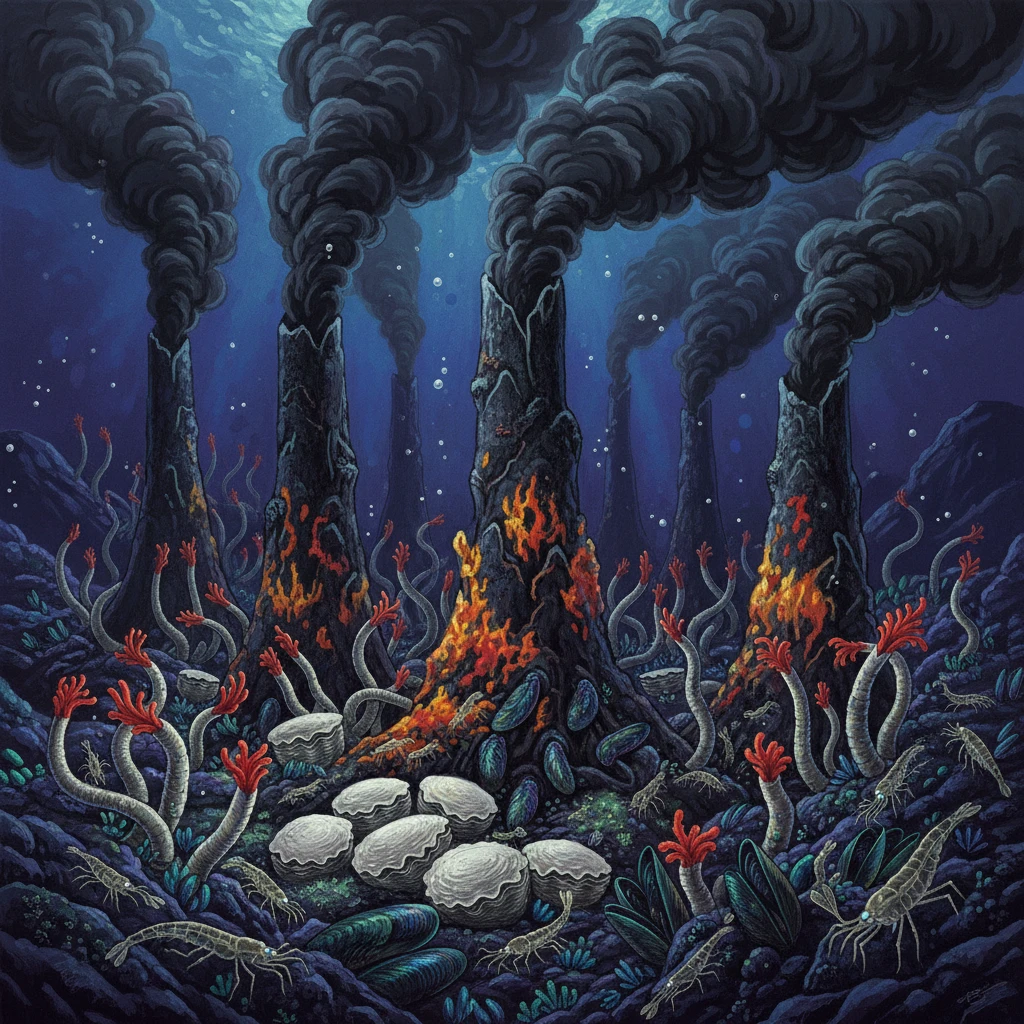
These abyssal 'oases' are found around underwater hydrothermal vents, known as 'black smokers' or 'white smokers'. In these cracks in the Earth's crust, seawater seeps in, heats to extreme temperatures (up to 400°C) by magma, and reacts with rocks, carrying minerals and chemical compounds such as hydrogen sulfide.
When this boiling, chemical-rich 'soup' is expelled back into the ocean, chemosynthetic bacteria jump into action. Unlike plants, which use sunlight for photosynthesis, these bacteria oxidize hydrogen sulfide and other compounds to produce energy, forming the base of a unique food chain.
Around these vents, surprising creatures have been discovered: giant tube worms with no mouth or anus that can grow up to 2.5 meters, large clams, mussels, and blind shrimp. These organisms have developed symbioses with chemosynthetic bacteria, hosting them in their bodies to obtain nutrients directly.
The discovery of these ecosystems in 1977 on the Galápagos Rift revolutionized our understanding of biology. It showed that life can emerge and flourish in extreme conditions, completely isolated from solar energy. This finding not only marvels us with the resilience of life on Earth, but also fuels hope of finding life on other celestial bodies with subsurface oceans, such as Europa or Enceladus, which could have their own hydrothermal vents and chemosynthetic processes. A true testament to the ingenuity of nature.
Source: National Geographic, Woods Hole Oceanographic Institution (WHOI)