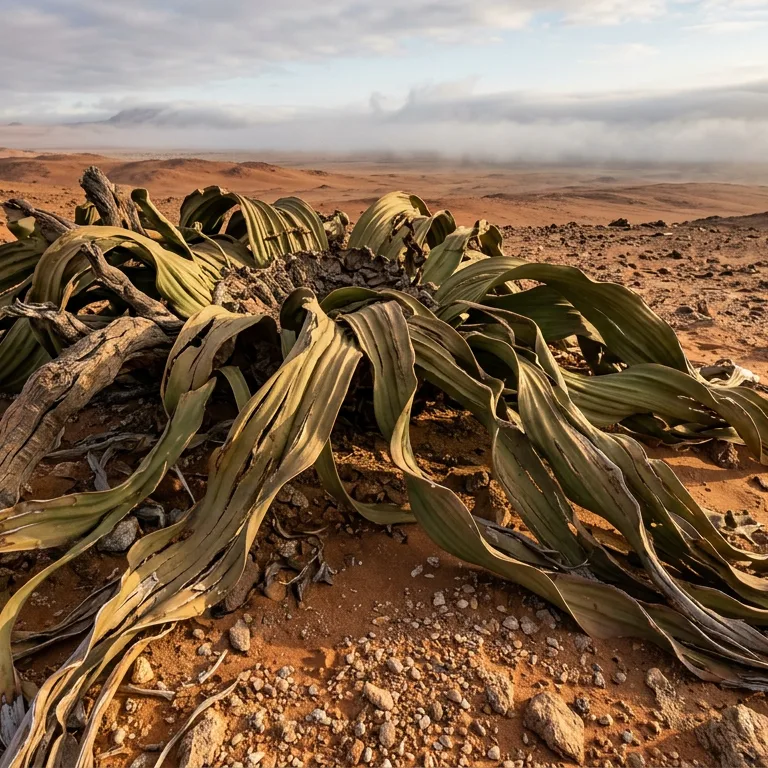
In one of the most inhospitable expanses on the planet, the Namib Desert, lives a botanical prodigy that defies the biological rules of the plant kingdom: Welwitschia mirabilis. At first glance it looks like a shapeless mass of dried, twisted ribbons, but in reality the entire organism consists of only two true leaves produced after germination, which never shed and continue growing uninterrupted for centuries.
Described in 1859 by Austrian botanist Friedrich Welwitsch, this long-lived gymnosperm displays extraordinary evolutionary traits:
- Continuous basal growth: Unlike most plants, its leaves grow from a basal meristem located at the crown of the stem, elongating at a steady rate of between 8 and 15 centimeters per year.
- The illusion of chaos: The constant abrasion of desert wind, scorching sun, and rocks tears the leaves lengthwise over time, giving it the appearance of dozens of tangled tentacles.
- Fog harvesters: With annual rainfall often under 10 millimeters, it survives thanks to thousands of stomata per square centimeter capable of absorbing the dew generated by dense Atlantic ocean fogs.
Radiocarbon dating confirms that many specimens exceed 1,000 to 1,500 years of age, and recent genomic studies have revealed that its genome underwent duplication millions of years ago, combined with epigenetic shielding that protects its cells from heat damage and extreme ultraviolet radiation.
Source: Nature Plants (Study of the Welwitschia mirabilis genome and adaptations to aridity)