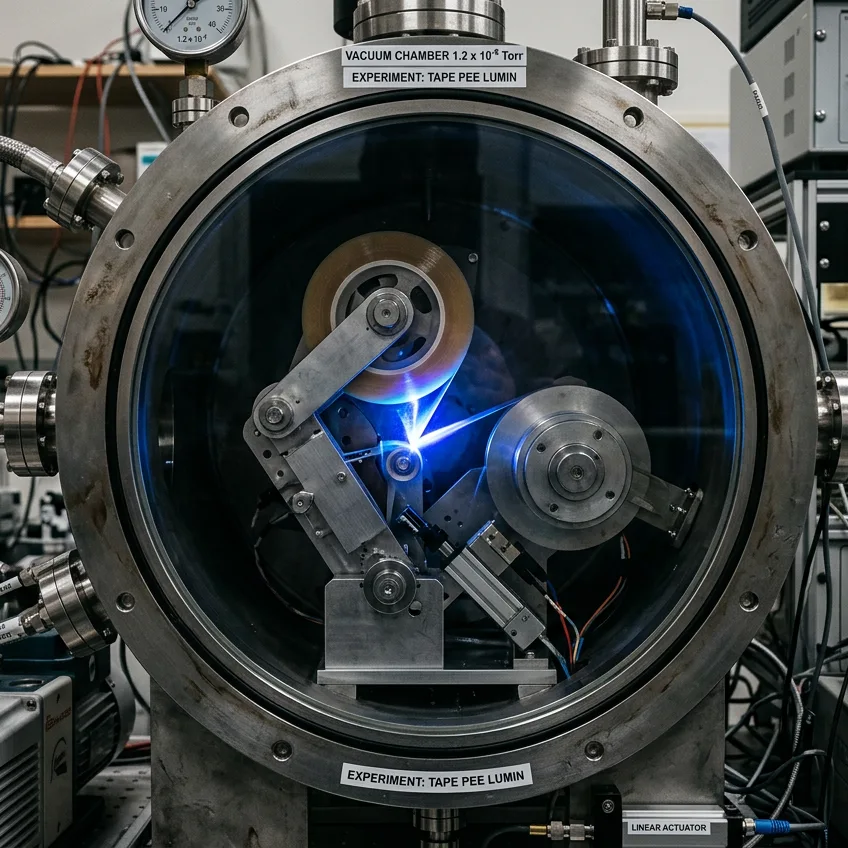
In 1953, a group of Soviet scientists observed a faint bluish glow when unrolling adhesive tape in the dark. It was triboluminescence, a physical phenomenon in which the breaking of chemical bonds generates visible light emission. However, in 2008, a team of physicists from the University of California, Los Angeles (UCLA) decided to take the test to extreme conditions and discovered something that baffled the world: peeling commercial cellophane tape inside a vacuum chamber generates bursts of high-energy X-rays.
The mechanism is triggered by a brutal electrostatic transfer:
- As the adhesive separates from the plastic at a constant speed of 3 centimeters per second, a gigantic electrical potential difference occurs.
- In a vacuum, with no air molecules to gradually dissipate the charge, electrons freely accelerate toward the positive surface at astonishing speeds.
- When these electrons strike the roll at high speed, they decelerate violently, releasing their kinetic energy as braking radiation or Bremsstrahlung.
The pulses detected in the laboratory lasted just billionths of a second, but reached energies of up to 15 kilovolts. To demonstrate the phenomenon's potential, researchers placed a detector and managed to capture a sharp, perfectly visible X-ray of the phalanges of a human finger, revealing that everyday friction can behave like a miniature particle accelerator.
Source: Nature (Camara, Escobar, Hird & Putterman, 2008: 'Correlation between nanosecond X-ray flashes and stick-slip friction in peeling tape')