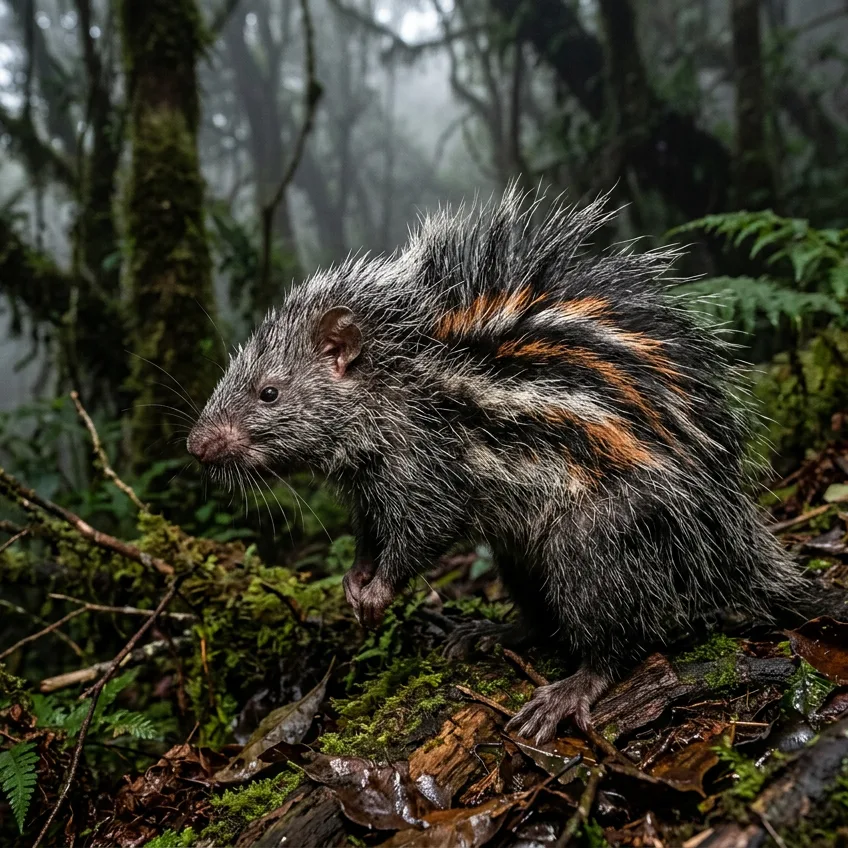
An unusual rodent lives in the mountain forests of East Africa: the African crested rat (Lophiomys imhausi). For generations, local stories warned that dogs daring to bite this animal dropped dead or suffered cardiac arrest. In 2011, science confirmed it was not a myth: it is the only known mammal capable of acquiring and weaponizing its own body with lethal plant poison.
The secret of its defense comes from the Acokanthera schimperi tree, the same plant traditionally used by local tribes to poison the tips of their arrows. The rat deliberately chews the bark of this tree, loaded with ouabain, an extraordinarily potent cardiotoxic glycoside capable of triggering fatal arrhythmias in minutes. The rat does not die of poisoning thanks to specific evolutionary mutations in its cellular sodium-potassium pumps, which block the toxin's action.
After grinding the bark, the rodent grooms itself by smearing the toxic saliva onto specialized hairs along its flanks. These hairs possess a unique microscopic architecture: they are not solid, but porous cylinders perforated with a lattice structure that works like a chemical wick, retaining the poison for weeks.
- Warning strategy: When threatened, the animal raises its dorsal crest and exposes black and white lateral stripes that reveal the lethal zone.
- Biological armor: It has unusually thick skin and a reinforced skull to withstand the initial bite.
- Instant effect: As soon as the predator presses its mouth against the spongy hairs, the ouabain penetrates directly into its oral mucous membranes, forcing an immediate retreat or cardiac collapse.
Source: Proceedings of the Royal Society B (Kingdon et al., 2011 / Tinnert et al., 2020)