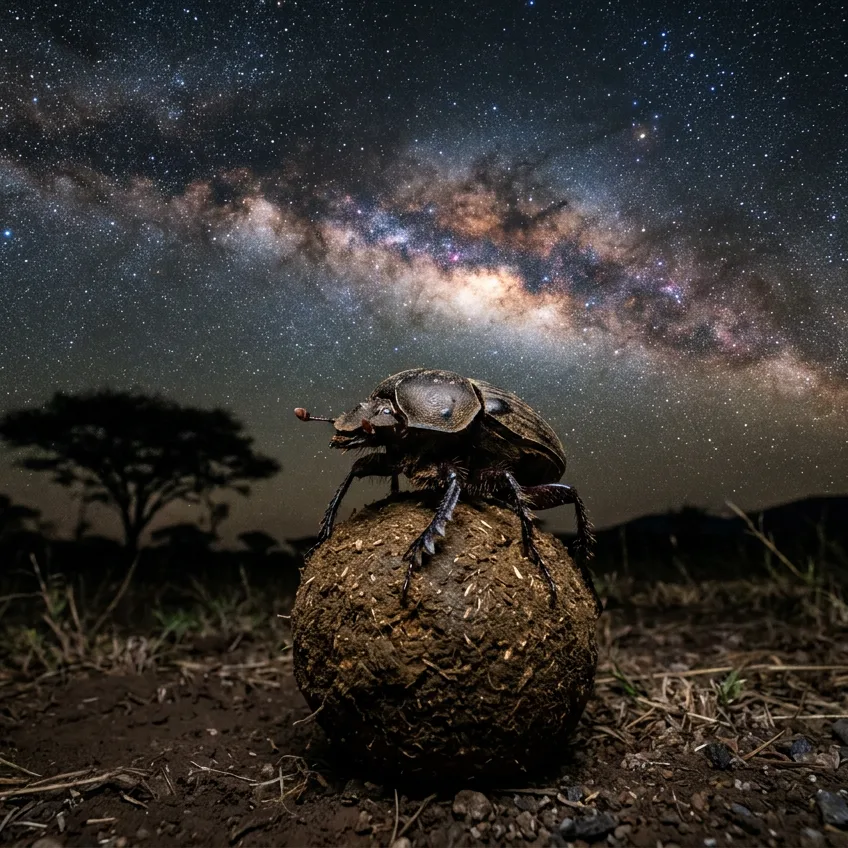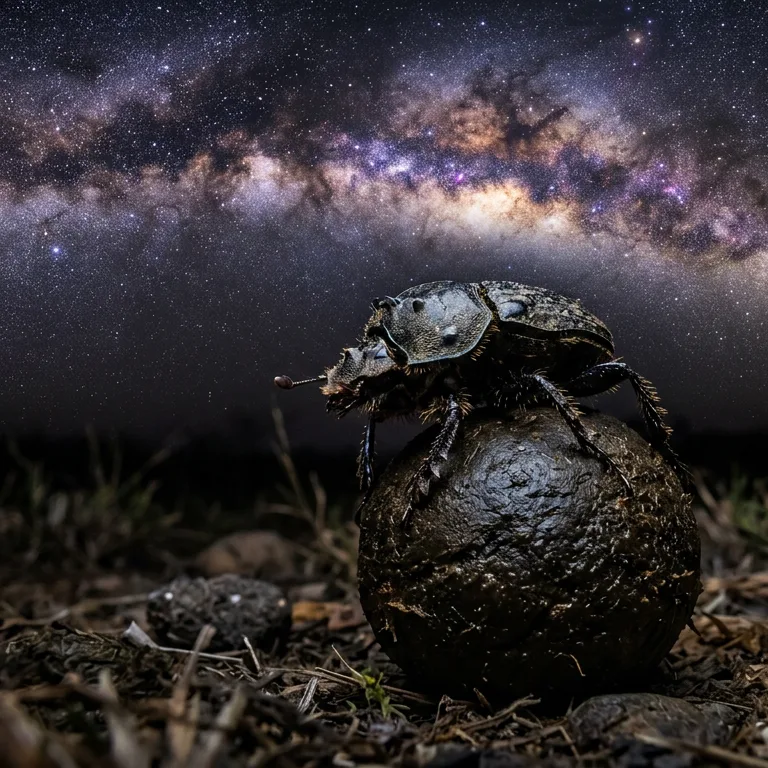
Rolling a dung ball on a moonless night sounds like a simple task, but on the African savanna it is a matter of life and death. Dung beetles compete fiercely with one another: if an individual does not move away from the dung pile in a strictly straight path, it runs the immediate risk of circling back to its starting point and being stripped of its prize by opportunistic rivals.
For decades it was known that these insects use the Sun's polarization pattern by day and the Moon on clear nights. However, in 2013, a team of biologists from Lund University led by researcher Marie Dacke revealed an unprecedented astronomical feat: on clear, moonless nights, the nocturnal dung beetle (Scarabaeus satyrus) maintains its course by locking onto the faint glow of the Milky Way.
To test this empirically, the scientists took the insects to the Johannesburg Planetarium and manipulated the projection of the night sky:
- Under a dome recreating the galaxy's milky band, the beetles rolled their balls in perfectly straight paths.
- When turning off the Milky Way and leaving only isolated stars, or when fitting them with tiny black cardboard caps that blocked their upward field of view, they lost their way and traced chaotic loops.
The beetle's compound eyes lack the resolution to focus on individual stars, but its visual system integrates the light contrast of the galactic stellar belt as an infallible overhead compass, making it the only confirmed animal capable of navigating guided by the galaxy.
Source: Current Biology (Dacke et al., 'Dung Beetles Use the Milky Way for Orientation', 2013) / Lund University