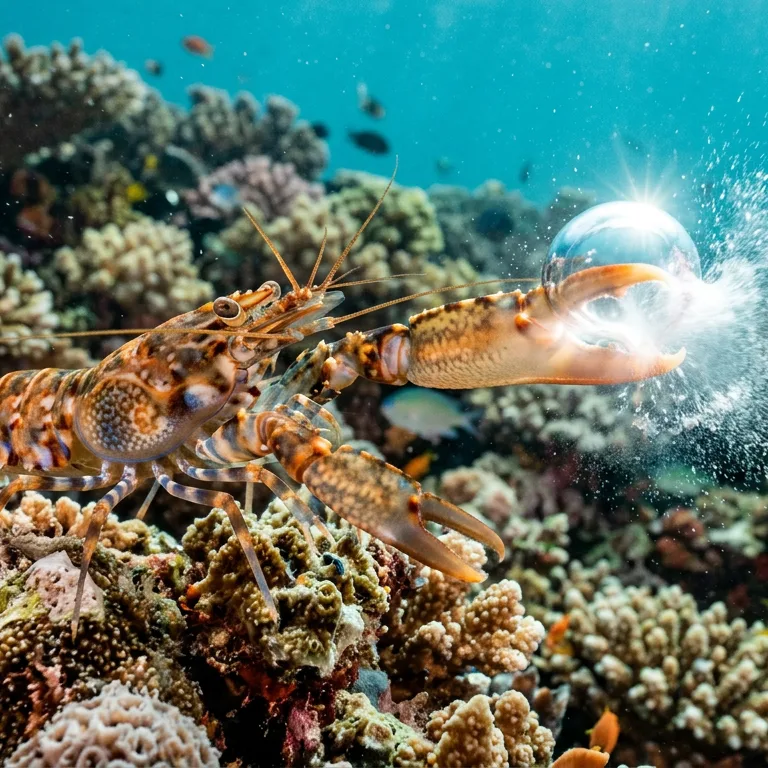
In tropical reefs lives a creature barely five centimeters long capable of unleashing one of the most extreme physical phenomena in the animal kingdom: the pistol shrimp (family Alpheidae). Unlike other marine predators that rely on sharp teeth or paralyzing toxins, this crustacean uses fluid hydrodynamics as a lethal weapon.
The secret lies in its hypertrophied claw, equipped with a biological trigger mechanism. Snapping shut at a speed over 100 km/h, the claw does not strike its prey directly, but shoots out an extremely powerful jet of water at high speed. This flow causes local pressure to plummet below the vapor pressure of water, almost instantly generating a low-pressure cavitation bubble.
The astonishing part happens a fraction of a millisecond later, when external pressure violently crushes the bubble:
- Stunning shockwave: The collapse generates an acoustic detonation exceeding 210 decibels, louder than a jet engine takeoff, instantly knocking out or killing small fish and crabs.
- Extreme heat: The adiabatic compression of vapor in the core of the bubble momentarily raises the temperature above 4,500 °C, approaching the surface temperature of our solar star.
- Sonoluminescence: The collapse is so violent that it produces a brief flash of optical light invisible to the human eye without high-precision instruments.
This blast turns the modest pistol shrimp into one of the loudest creatures in the ocean, to the point that their colonies frequently blind naval and military sonar.
Source: Nature / Detlef Lohse et al., 'Snapping shrimp make flash of light' (University of Twente)