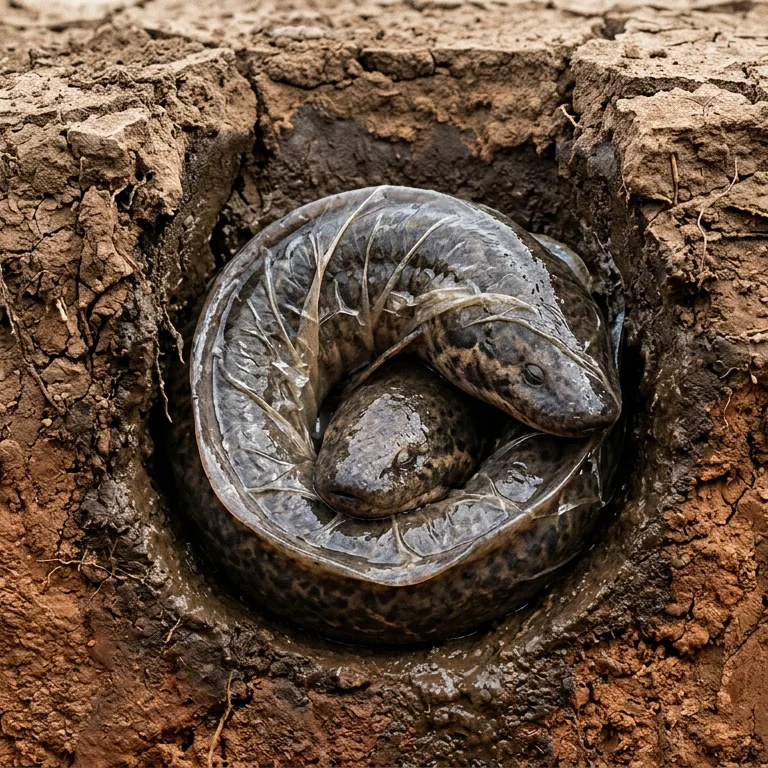
When the dry season hits the African plains and river pools evaporate into a cracked crust of earth, almost any creature with fins would die in a matter of hours. However, the African lungfish (Protopterus annectens) has a unique evolutionary strategy: before the water disappears, it dives into the mud, digs a burrow with its mouth about 30 to 50 centimeters deep, and prepares to hibernate beneath the scorching sun.
Once buried, this ancestral vertebrate enters a state of deep torpor known as aestivation. To avoid dehydration, its skin secretes abundant amounts of thick mucus that dries and hardens around its body, forming a waterproof sheath very similar to cellophane. This cocoon seals the animal completely, except for a tiny chimney opening to the surface that allows it to breathe atmospheric air using its true lungs, since its gills are useless out of water.
During this confinement, the fish performs astonishing physiological feats:
- Slows its biological clock: It reduces its metabolic rate to less than 10 % of its normal pace, consuming its own muscle reserves to stay alive.
- Extreme toxin tolerance: It suspends urine production and stores massive concentrations of urea in its tissues, levels that would be fatal to any other vertebrate.
In this underground cocoon, the lungfish can endure not just months, but up to four or five years without tasting a drop of water or a bite of food. When the rains finally return and flood the parched earth, the mud softens, the protective cocoon dissolves, and the fish wakes from its torpor to swim as if no time had passed.
Source: Journal of Experimental Biology / American Museum of Natural History