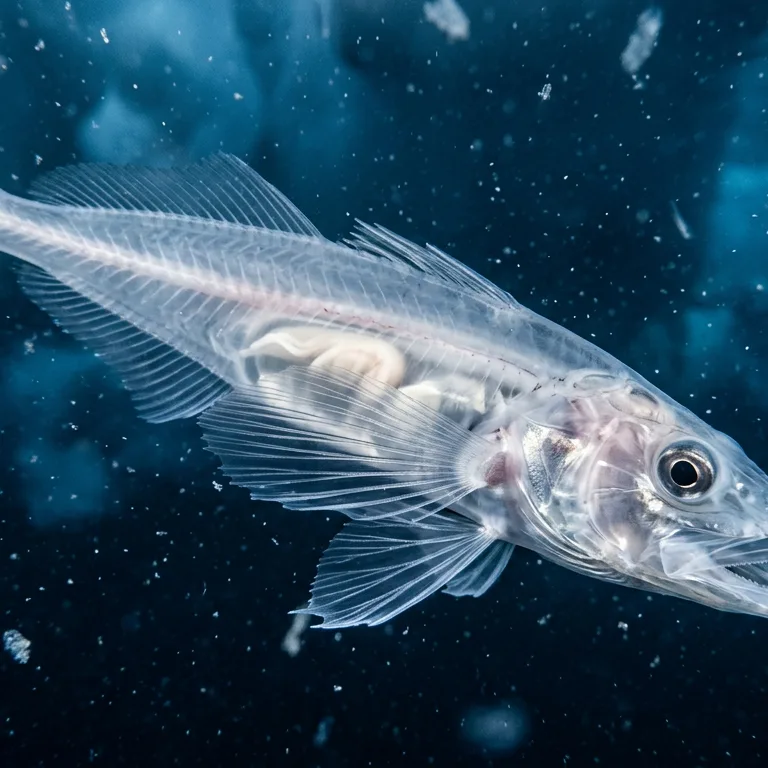
In the freezing depths of the Southern Ocean lives a creature that defies one of the most universal biological rules of vertebrates: the Antarctic icefish (from the family Channichthyidae), such as the species Chaenocephalus aceratus. Unlike any other known fish, bird, reptile, or mammal, these animals completely lack hemoglobin, the iron-rich protein responsible for transporting oxygen and giving blood its characteristic red color.
As a result of this mutation, their circulatory fluids appear milky or completely transparent. To survive under such conditions without this vital molecular vehicle, the icefish developed extraordinary physiological adaptations:
- Oxygen dissolved in plasma: Antarctic water, at temperatures hovering around -1.8 °C, contains colossal concentrations of dissolved oxygen. This allows the gas to transfer directly and passively into the fish's blood plasma without needing protein carriers.
- An oversized circulatory system: To compensate for the lower transport density, its heart is proportionally up to three times larger than that of other fish, its capillaries are remarkably wider, and it pumps up to four times more blood volume.
- Biological antifreeze: Its tissues synthesize specialized glycoproteins that physically prevent the nucleation and formation of ice crystals inside its blood vessels.
Formally documented in 1927 by Norwegian biologist Ditlef Rustad on South Georgia Island, icefish are a radical example of how polar evolutionary pressure made it possible to discard traits considered essential for complex vertebrate life.
Source: Polar Biology / University of Oregon Evolutionary Genomics Lab