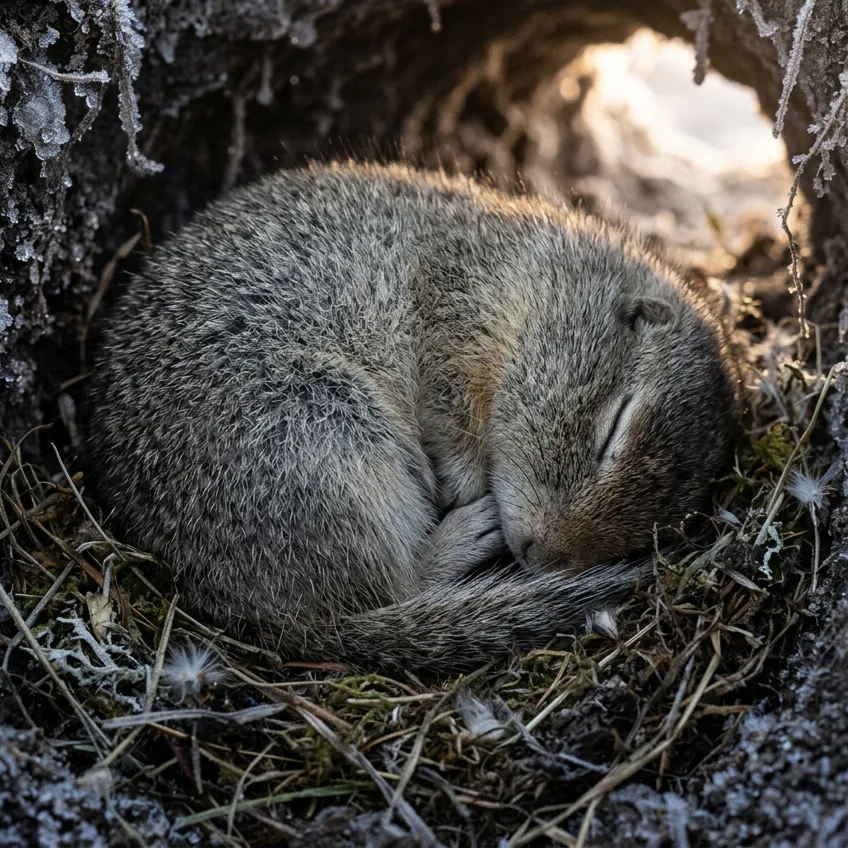
During the harsh winters of the tundra in Alaska and northern Canada, the Arctic ground squirrel (Urocitellus parryii) defies a limit that no other known mammal can cross: it survives with a core body temperature as low as -2.9 °C in an absolute liquid state, without freezing.
In any other mammal, subzero temperatures cause ice crystals to form, tearing cell membranes and destroying tissues. This small squirrel avoids death through a biophysical marvel known as supercooling:
- Purification of nucleating agents: Before entering torpor, its body actively purges its blood, removing microscopic particles and bacteria that could act as catalysts to start the crystallization of biological water.
- Controlled metabolic collapse: Its heart rate plummets from 350 beats per minute to just one or two per minute. Its oxygen consumption drops to less than 2% of normal, and cerebral blood flow decreases by 90%.
- Programmed thermal intermittence: Every two or three weeks, it activates its brown adipose tissue and begins shivering vigorously to warm its body back up to 37 °C for about twelve hours, restoring its neural connections and immune system before cooling below zero once again.
This natural thermal shield has made the Arctic squirrel the greatest hope of modern cryogenic medicine to design protocols for preserving human organs for transplants for weeks without cellular damage.
Source: Science / University of Alaska Fairbanks (Studies by Brian M. Barnes on 'Freeze avoidance in a mammal')