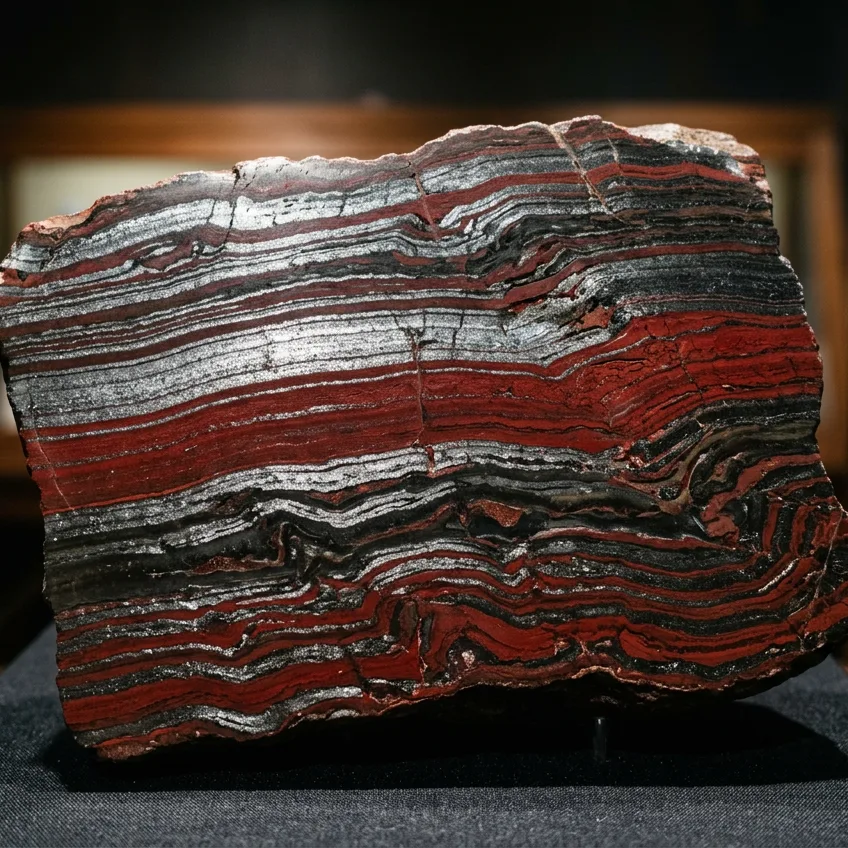
In the Archean eon, Earth's oceans had a greenish, hostile appearance. Lacking free oxygen, their waters harbored colossal amounts of dissolved ferrous iron from the mantle and submarine hydrothermal activity. However, about 2,400 million years ago, a silent microscopic revolution altered the planet's chemistry forever: the proliferation of cyanobacteria and oxygenic photosynthesis.
As these microorganisms released oxygen as a metabolic waste product, the gas did not escape directly into the atmosphere. Instead, it reacted instantly with the iron dissolved in seawater, triggering a global-scale chemical oxidation. The iron transformed into insoluble oxides, mainly hematite and magnetite, which precipitated to the ocean floor in a dense rain of mineral rust.
This cyclical process left an unmistakable geological footprint known as Banded Iron Formations (BIFs): rhythmic millimeter-scale strata where shiny layers of black or reddish iron oxides alternate with bands of jasper and crystalline silica. Seasonal variations or pulses in biological activity generated this unique stratified pattern, which ceased almost completely when the iron in the seas was definitively exhausted.
Today, deposits such as those in Pilbara in Western Australia or Carajás in Brazil are not only the largest iron ore deposits on the planet—supplying more than 60 % of modern steel—, but also the tangible geological proof of the Great Oxidation Event, the biological crisis that poisoned primitive anaerobic organisms and laid the foundation for complex life.
Source: Geological Society of America / Nature Geoscience