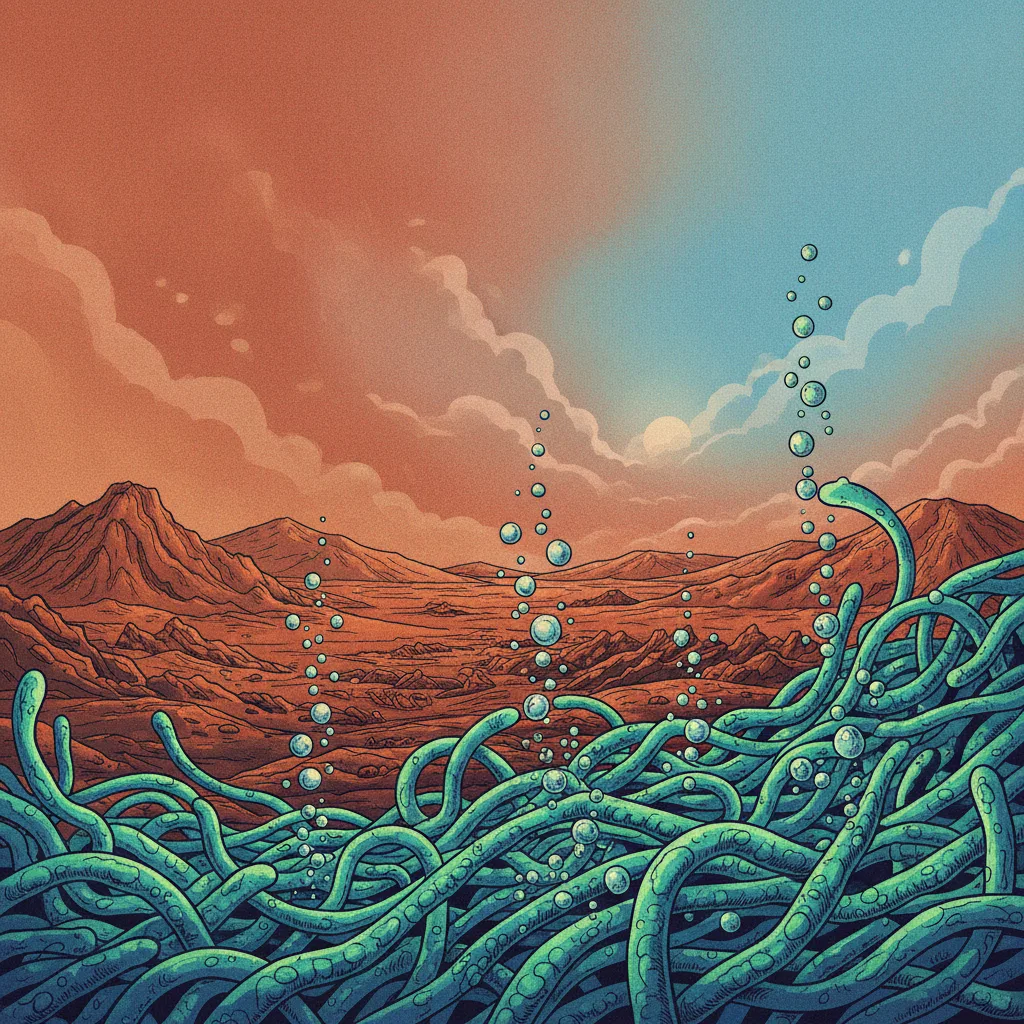
In Earth's early days, the oceans were not blue, but of a greenish hue due to gigantic concentrations of dissolved ferrous iron (Fe2+). The atmosphere almost completely lacked free oxygen, so this metal remained perfectly dissolved in the water. However, about 2,400 million years ago, a biological revolution occurred: cyanobacteria invented oxygenic photosynthesis and began releasing oxygen as metabolic waste.
Instead of accumulating in the air, that gas—lethal to anaerobic microbes—instantly reacted with oceanic iron. The result was chemical precipitation on a planetary scale: iron oxidized into its insoluble ferric form (hematite and magnetite) and plunged to the seafloor in a constant 'rain of rust.' This process was deposited cyclically, alternating with sediments of silica or red jasper, creating stratified rocks with rhythmic, polished bands known worldwide as Banded Iron Formations (BIFs).
The phenomenon acted as a geochemical buffer for hundreds of millions of years. Until virtually all dissolved iron in the seas had oxidized and settled to the bottom, free oxygen could not escape into the atmosphere to trigger the Great Oxidation Event.
The footprint of this biological cataclysm is colossal for our era: more than 90% of all iron ore that humanity mines today to produce steel comes directly from these Precambrian deposits. Every modern skyscraper, bridge, or vehicle is forged from the rust that microscopic bacteria precipitated to the bottom of a primitive ocean.
Source: Geological Society of America (GSA) - Banded Iron Formations and the Great Oxidation Event