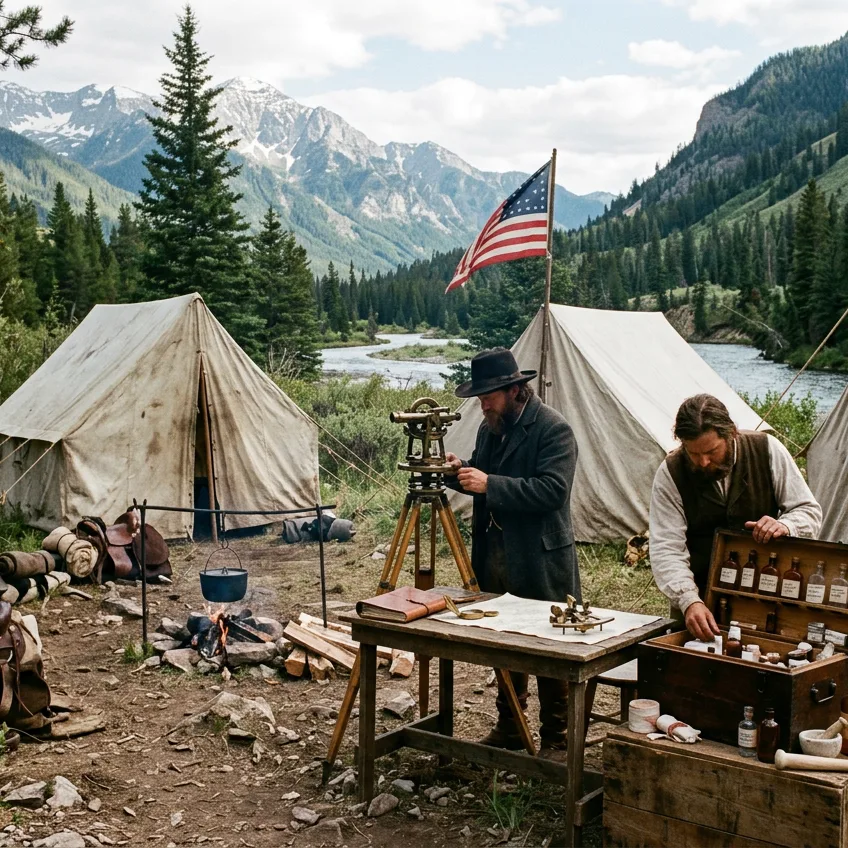
Between 1804 and 1806, explorers Meriwether Lewis and William Clark led the historic military expedition that crossed the uncharted West of North America to reach the Pacific Ocean. To ensure the platoon's health in unknown territories, the renowned physician of the era Benjamin Rush prepared an abundant military medical kit for them, prominently featuring hundreds of doses of his signature purgative: bilious pills, dubbed by the troops as "thunderclappers".
That medical preparation promised to break fevers and stomach ailments through violent, immediate bowel evacuation. Its secret formula was based on mercury chloride (calomel), a highly toxic chemical compound that made up nearly 60% of each pill's mass. Because the human body barely absorbs this heavy metal in the digestive tract, the substance was expelled almost intact directly into makeshift latrines along thousands of kilometers of the trail.
Nearly two hundred years later, this peculiar medical treatment solved one of the greatest challenges in American historical archaeology:
- Invisible campsites: The passage of centuries and river erosion erased any trace of stakes, fires, and tents across the vast wilderness plains.
- Indelible chemical signature: Mercury is a persistent element that does not break down biologically, binding strongly to the subsoil substrate.
- Unambiguous identification: By analyzing soil samples at key sites such as Travelers' Rest (Montana), archaeologists found extreme mercury anomalies in waste pits, confirming the exact location of the expedition's latrines in 1805 and 1806.
Thanks to the harshest laxative of nineteenth-century medicine, the legendary expedition left an indelible chemical footprint that turned its former latrines into scientific coordinates of incalculable historical value.
Source: Smithsonian Magazine / National Park Service (U.S. Department of the Interior)