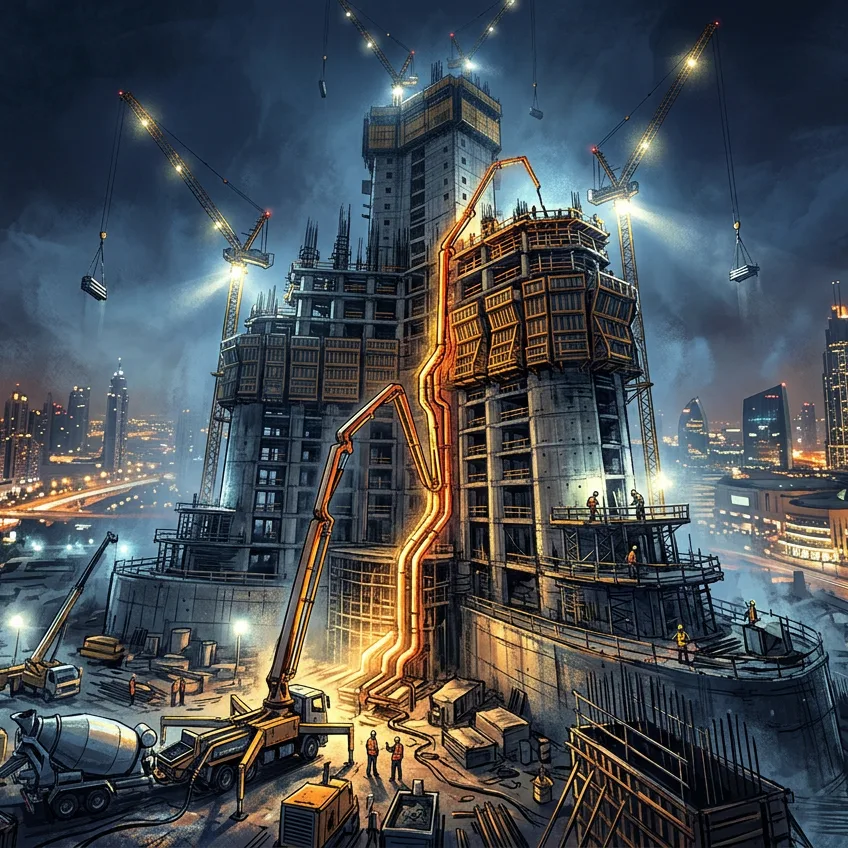
Erecting the 828 meters of the Burj Khalifa in Dubai was not only an architectural challenge, but one of the greatest feats ever achieved in materials and fluid engineering. The core structure required thousands of tons of reinforced concrete, but a critical dilemma emerged: how could tons of semisolid mass be raised over half a kilometer high without the pipes bursting or the material solidifying on the way?
To achieve this in a single continuous stage up to 606 meters (a world record for vertical pumping), engineers relied on hydraulic pumps capable of generating colossal pressures of up to 320 bars, equivalent to the weight of a car concentrated on the tip of a finger. However, the greatest enemy was the climate: in the Arabian desert, daytime temperatures routinely exceed 45 °C, which would have accelerated cement hydration, clogging the conduits and creating an indestructible plug of rock inside the system.
The solution combined thermodynamics and advanced chemistry:
- Nighttime pumping: All vertical concreting was performed exclusively after nightfall, taking advantage of lower temperatures.
- Ice in the mix: A large portion of the mixing water was replaced with crushed ice, allowing the concrete to leave the mixers at just 28 °C to delay its setting.
- Millimetric rheology: Superplasticizers and silica fume were used to keep the mix fluid during the ascent and transform it, once set, into rock capable of withstanding 80 megapascals of compression.
Source: Putzmeister Concrete Technology Case Studies / American Concrete Institute (ACI)