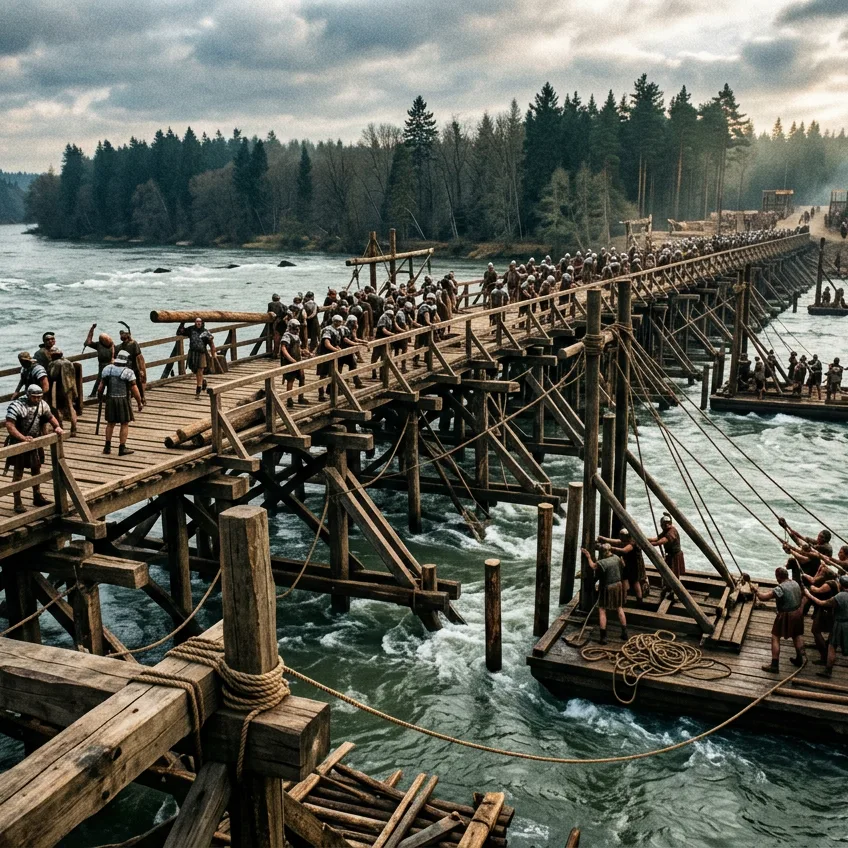
During the Gallic Wars, in the year 55 BC, hostile Germanic tribes believed they were safe on the other side of the Rhine River, a formidable natural barrier more than 300 meters wide, with turbulent waters and up to nine meters deep. Navigating it in boats posed a tremendous tactical risk, so Julius Caesar made an unprecedented decision: he ordered his legions to build a solid wooden bridge from scratch.
The engineering feat was extraordinary. Roman soldiers and carpenters drove double angled piles into the riverbed using barges equipped with pulley-driven pile drivers. They added crossbeams 60 centimeters thick, embankments to dissipate the force of the current, and protective palisades upstream against floating logs that the Germans might launch as battering rams. In barely ten days, they raised a passable structure nearly 400 meters long.
The crossing was not aimed at permanent territorial occupation, but rather at a devastating psychological demonstration:
- Lightning impact: Seeing 40,000 legionaries march across the water, neighboring tribes fled to take refuge in the forests and immediately sent peace envoys.
- Message of power: After eighteen days on Germanic soil burning villages loyal to the rebels and securing alliances, Caesar returned to Gaul.
- Deliberate demolition: Upon crossing back, he ordered the bridge completely torn down behind him, making it clear that Rome crossed indomitable rivers only when it wished, without leaving open access for the enemy.
Source: Julius Caesar, 'Commentarii de Bello Gallico' (Book IV) and archaeological research from Universität Trier.