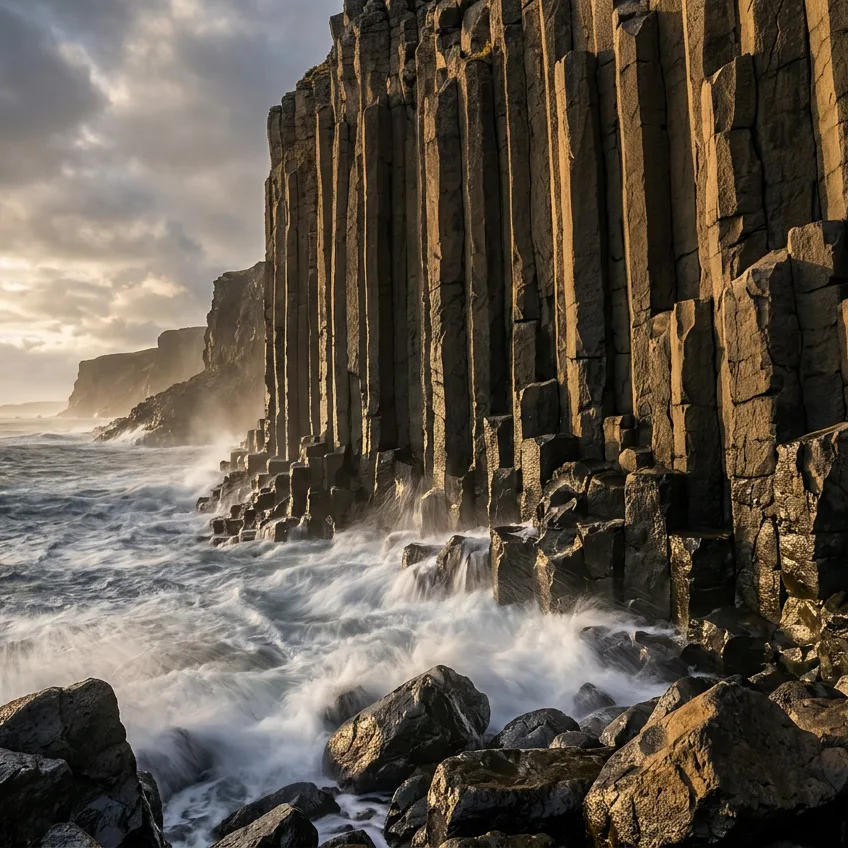
In sites as famous as the Giant's Causeway in Northern Ireland, Fingal's Cave in Scotland, or the natural monument of Los Órganos in La Gomera, the landscape appears to have been carved by hand by geometry-obsessed architects: thousands of stone pillars, mostly with six astonishingly symmetrical faces, rise vertically toward the sky. This geological wonder is called columnar jointing.
Far from requiring artificial intervention, these formations are the pure result of thermodynamics and fracture mechanics. When a dense basaltic lava flow ponds and begins to cool slowly and uniformly, a precise physical choreography is triggered:
- Cooling contraction: As it drops from more than 1,000 °C and solidifies, the rock reduces in volume. This shrinkage generates immense surface tensile stress that can only be relieved by opening cracks.
- The 120-degree rule: Nature always seeks the path of least resistance. To dissipate the maximum accumulated stress with the least possible mechanical work, fractures must intersect at 120-degree angles.
- The hexagonal pattern: The only regular planar geometric tessellation based on 120-degree junctions is the hexagon, the same principle of minimal surface area that guides bee honeycombs.
As the cooling front advances into the interior of the flow at a rate of just a few centimeters per day, the cracks propagate perpendicularly into the depth, carving columns up to tens of meters high that freeze in stone the thermal pulse of a prehistoric volcano.
Source: Physical Review Letters / Journal of Geophysical Research: Solid Earth