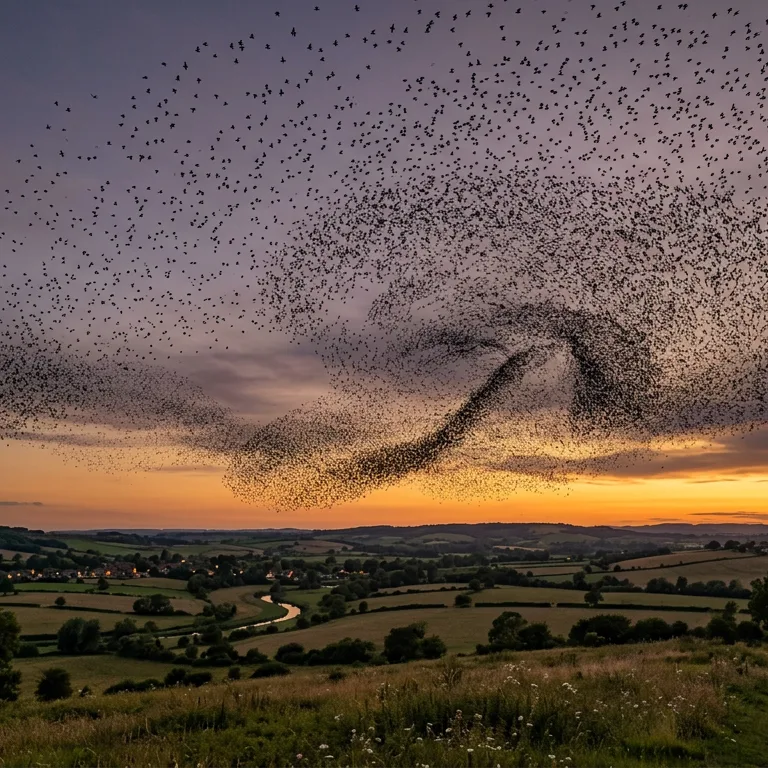
At dusk in European skies, thousands of common starlings (Sturnus vulgaris) gather to form gigantic, fluid clouds that shift shape in milliseconds. These aerial dances, known as murmurations, frequently bring together more than a hundred thousand individuals flying at over 50 kilometers per hour without ever colliding with one another.
For decades, biologists mistakenly believed there was a leader or some form of animal telepathy. However, in 2010 an interdisciplinary team from Italy's Consiglio Nazionale delle Ricerche unraveled the physical mystery after analyzing three-dimensional high-speed footage in Rome: starlings are governed by a rule of topological distance, not metric distance.
The keys to this instantaneous coordination are astonishing:
- The rule of seven neighbors: Each starling does not track birds within a certain distance in meters, but rather the exact position and velocity of precisely the seven nearest birds around it.
- Critical reaction speed: When one bird detects a predator, such as a peregrine falcon, and turns in under 100 milliseconds, the kinematic command propagates through the entire cloud with almost no attenuation, like a spin wave in particle physics.
This decentralized mathematical system allows the flock to act as a superorganism with an almost infinite response, evading raptors through a hypnotic spectacle of pure statistical mechanics.
Source: PNAS (Proceedings of the National Academy of Sciences) - 'Scale-free correlations in starling flocks', 2010