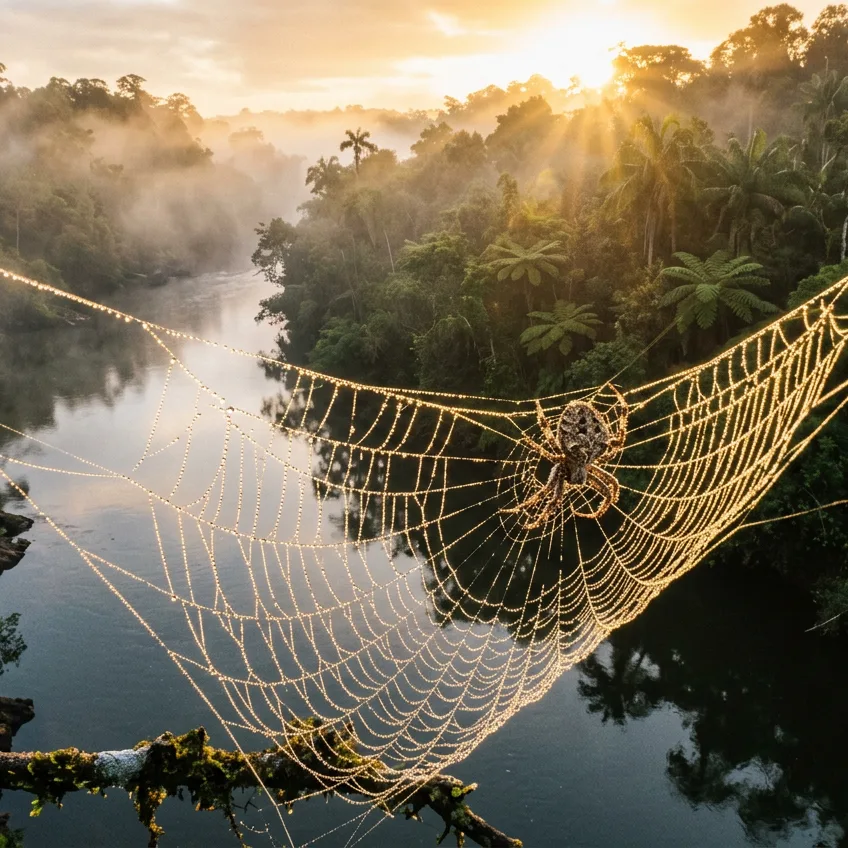
In the tropical forests of Madagascar lives a weaver with unmatched biophysical capabilities: Darwin's bark spider (Caerostris darwini). Formally described in 2009, this species does not exceed two centimeters in size, yet it can create the most extensive orb webs in the animal kingdom, reaching up to 2.8 square meters suspended over flowing rivers and lakes.
To span water chasms that no other terrestrial predator can bridge, the female perches on riverside vegetation and continuously sprays a continuous strand of silk carried by thermal air currents. The filament crosses entire riverbeds of up to 25 meters in length until anchoring to the opposite bank, serving as the structural bridge that supports its aerial trap suspended in midair.
What is truly extraordinary lies in the molecular composition of this anchor silk (composed of unique spidroin proteins, MaSp1 and MaSp2):
- It has an average toughness of 350 MJ/m³, twice that of any other known spider silk.
- It is ten times tougher than Kevlar, the high-strength synthetic material used in bulletproof vests.
- It withstands massive kinetic impacts without breaking, allowing it to trap dragonflies and mayflies in mid-flight skimming over the water.
This marvel of natural engineering makes Caerostris darwini the producer of the toughest elastic, energy-absorbing biomaterial known in the biosphere.
Source: PLOS ONE (Agnarsson et al., 'Bioprospecting Finds the Toughest Biological Material: Extraordinary Silk from a Giant Riverine Orb Spider')



