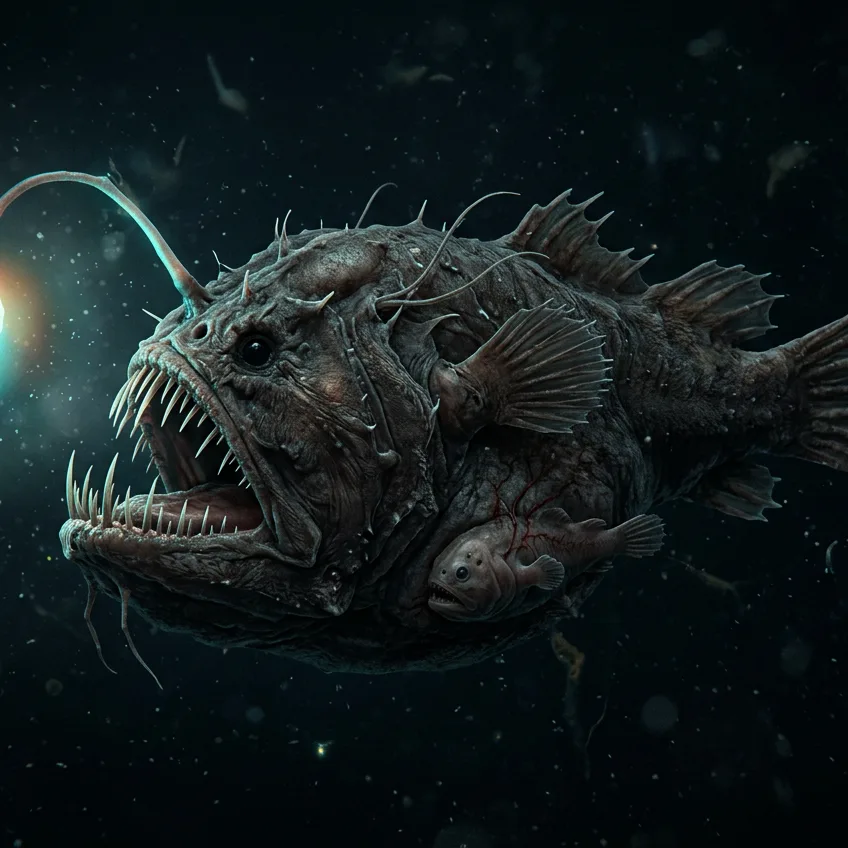
In the suffocating gloom of the deep ocean, where population density is nearly zero, finding a mate is an almost impossible odyssey. To solve this, several species of deep-sea anglerfish (suborder Ceratioidei) developed one of the most baffling reproductive strategies in the animal kingdom: obligate sexual parasitism.
The male, considerably smaller and lacking the female's characteristic glowing lure, has oversized olfactory pits designed to track her pheromones in the dark. When he finally locates a mate—which can be up to sixty times larger in size—he bites into her belly. In a matter of weeks, their mouths and skin dissolve in a controlled manner, and their blood vessels intertwine until both share a single bloodstream. The male gradually loses his eyes, fins, and almost all of his vital organs, turning into a permanent source of sperm nourished by the female's blood.
For decades, this phenomenon baffled medical science: in any other vertebrate, such a union would trigger a violent organ rejection due to tissue incompatibility. However, research published in the journal Nature in 2020 revealed the mystery: over the course of their evolution, these species disabled essential components of the adaptive immune system, including major histocompatibility complex (MHC) genes and T-cell receptors. By relinquishing the defenses that protect almost all vertebrates against foreign pathogens, the anglerfish managed to make the biologically impossible compatible.
Source: Nature (Swann et al., 2020 / Max Planck Institute of Immunobiology and Epigenetics)