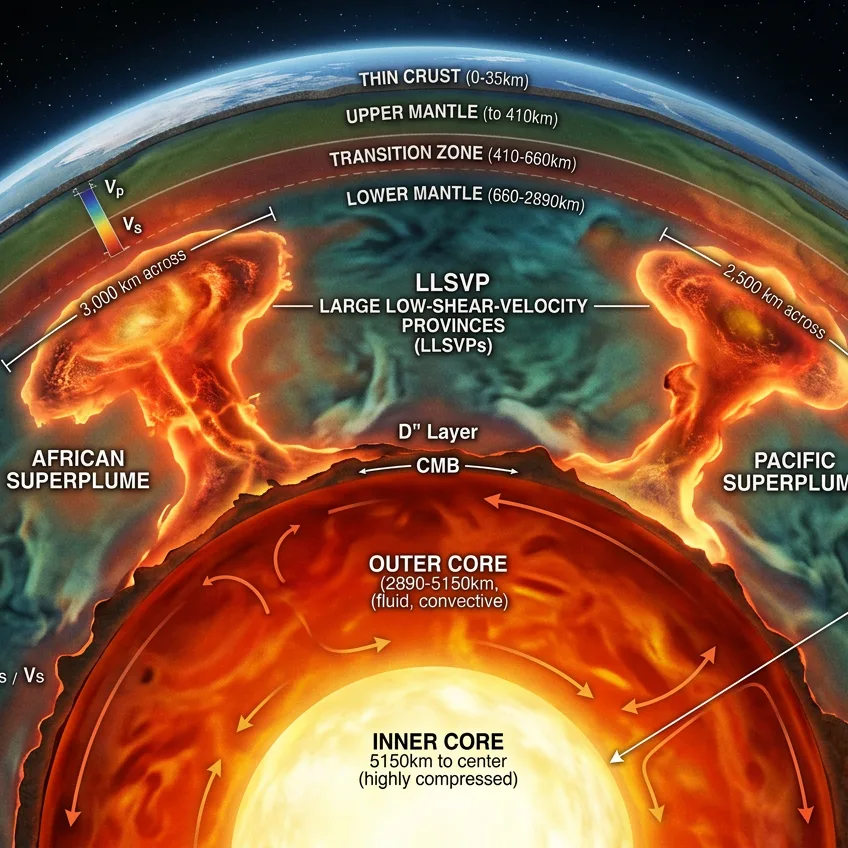
Nearly three thousand kilometers beneath our feet, at the exact boundary where the rocky mantle meets the blazing liquid iron outer core, hide the two most colossal and enigmatic geological structures on the planet. Known in geophysics as Large Low-Shear-Velocity Provinces (or LLVPs), these colossal formations were detected thanks to seismic tomography, a technique that uses waves from large earthquakes to x-ray the interior of the Earth.
Located one beneath the African continent (informally nicknamed "Tuzo") and another beneath the Pacific Ocean ("Jason"), these masses have staggering dimensions:
- Colossal height: They rise between 800 and 1,000 kilometers from the base of the mantle, making them one hundred times taller than Mount Everest.
- Enormous volume: They occupy nearly 8% of the entire volume of Earth's mantle and far exceed the combined mass of all the oceans on the planet.
For decades, their nature puzzled scientists. Seismic waves slow down dramatically when crossing these regions, confirming that they are not mere plumes of hot magma, but masses that are considerably denser, iron-rich, and chemically distinct from the rest of the surrounding mantle. In 2023, geodynamic research published in the journal Nature proposed a fascinating hypothesis: the LLVPs could be the buried remnants of Theia, the Mars-sized protoplanet that struck the early Earth 4,500 million years ago and whose ejected debris gave rise to the Moon.
Source: Nature (Geodynamic study led by Qian Yuan et al., Caltech, 2023)