For centuries, it was believed that pollinating insects found their way guided exclusively by the bright colors and scents of the plant kingdom. However, in 2013, a team of biophysicists from the University of Bristol proved the existence of an unsuspected communication channel: static electricity.
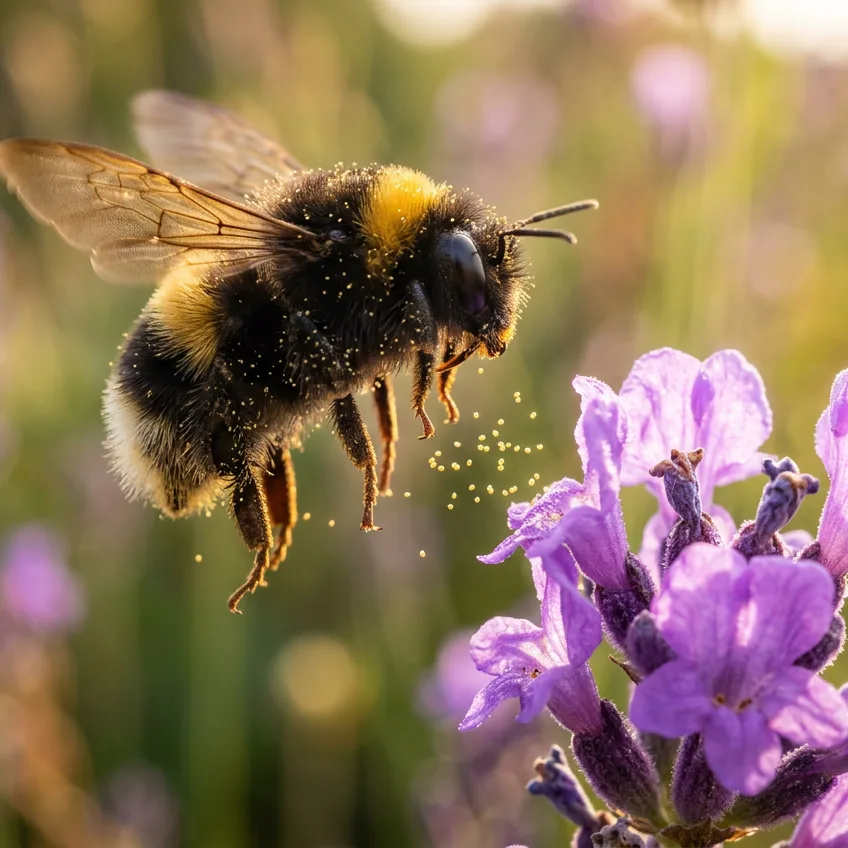
By flapping their wings hundreds of times per second, bees and bumblebees lose electrons through friction with air particles, accumulating a net positive electrical charge of hundreds of volts. In contrast, flowers are grounded to the soil and conduct a weakly negative electric potential. When the insect approaches the corolla, the potential difference creates an electrostatic attraction so powerful that pollen grains levitate and jump through the air onto the pollinator's hairs before it even lands.
The most fascinating discovery lies in what happens after contact: when the bee lands, it transfers part of its charge and modifies the flower's electric field for several minutes. Researchers proved that bumblebees (Bombus terrestris) detect this subtle alteration thanks to the movement that the electric force induces in the mechanosensory hairs of their antennae. If a flower displays an altered field, bees instantly understand that another forager has just emptied the nectar, avoiding wasted time and energy on an empty calyx.
This sophisticated bioelectric exchange shows that pollination is not merely a mechanical encounter, but an invisible physical dialogue finely calibrated by millions of years of evolution.
Source: Science (Clarke et al., 2013: 'Detection and Learning of Floral Electric Fields by Bumblebees')