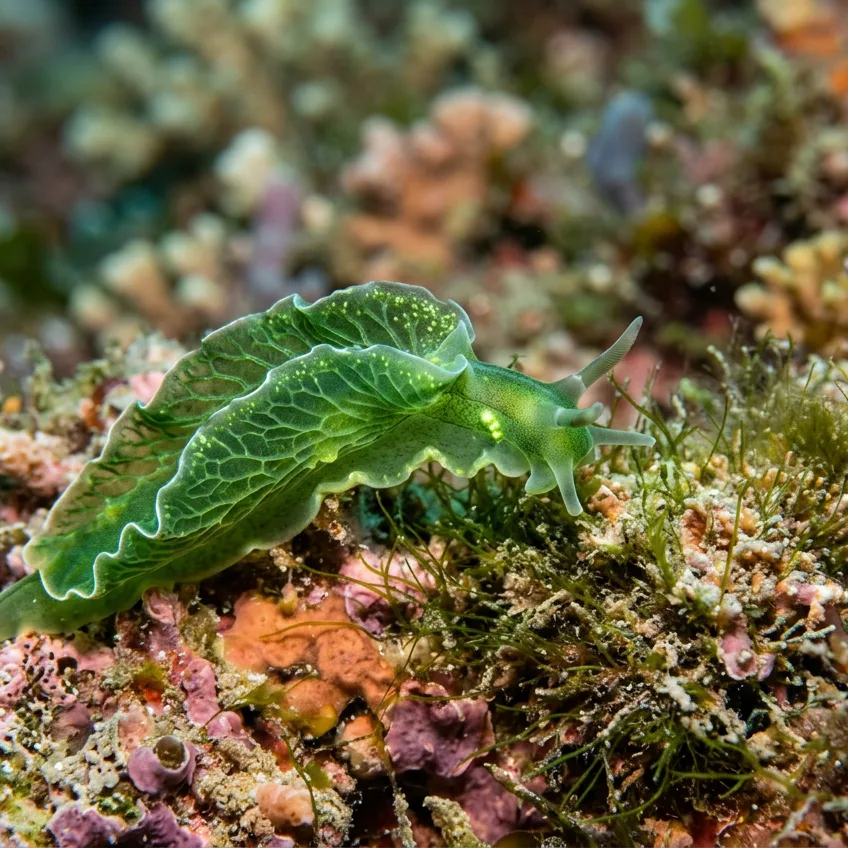
In the animal kingdom, losing your head is equivalent to instant death. However, for the photosynthetic sea slug Elysia marginata, decapitation is a calculated survival strategy. In 2021, biologists from Nara Women's University in Japan documented a phenomenon never seen before in complex organisms: young individuals of this species deliberately broke their own necks to get rid of a body filled with parasites.
The process, called extreme autotomy, does not leave a bleeding wound: the head seals the cut in just a couple of hours. What is most astonishing happens in the following days:
- Survival without a heart: Upon detaching from the body, the head leaves behind 80% of its biological mass, including the heart, kidneys, intestine, and reproductive system.
- Backup solar energy: To avoid starving while lacking a digestive tract, the head survives thanks to kleptoplasty, a mechanism by which the mollusk steals chloroplasts from the algae it eats and incorporates their photosynthesis.
- Total regeneration: In less than a week, heart tissue begins to form again; in just three weeks, the slug has rebuilt a pristine body free of parasites.
The discarded body, unable to regenerate a head, beats for months until it dies. This cellular feat positions Elysia marginata as one of the most extreme models of tissue regeneration and energetic symbiosis in the marine biosphere.
Source: Current Biology (Cell Press) - Study by Sayaka Mitoh and Yoichi Yusa on extreme autotomy and regeneration in sacoglossans (2021)



