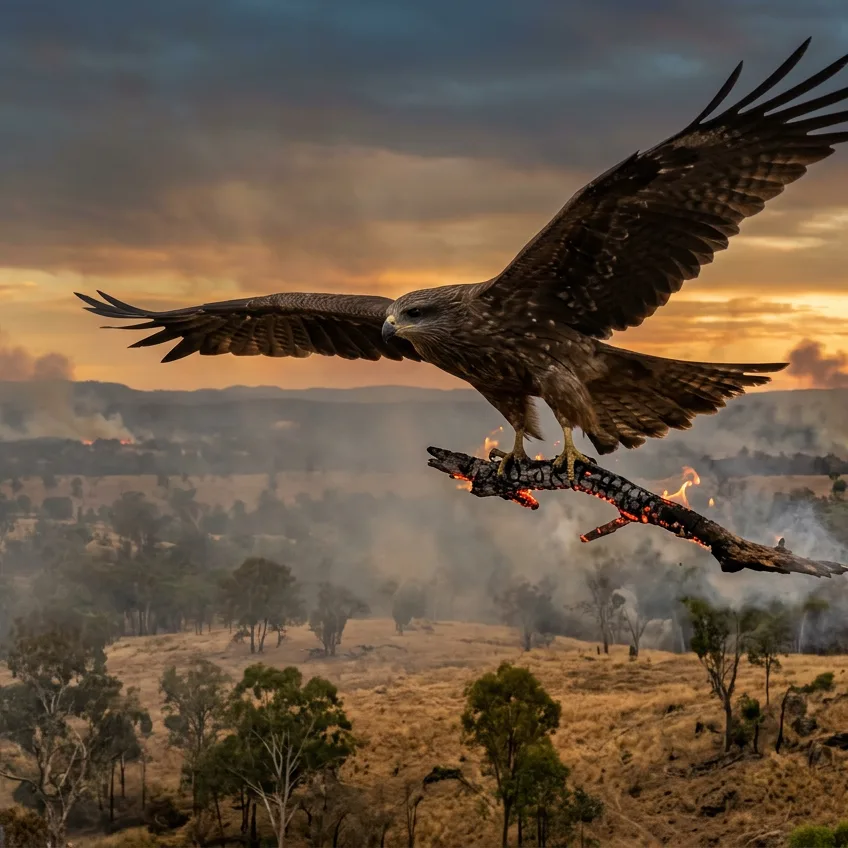
For millennia, Indigenous peoples of northern Australia told stories about birds that intentionally stoked and spread flames. In 2017, formal research published in the Journal of Ethnobiology confirmed this phenomenon: species such as the black kite (Milvus migrans), the whistling kite (Haliastur sphenurus), and the brown falcon (Falco berigora) use fire as an active predatory tool.
When a wildfire erupts in the Australian savanna, thousands of rodents, lizards, and large grasshoppers flee in terror from the smoke line, turning into an instant feast. However, when the fire front becomes blocked by natural barriers such as creeks, dirt tracks, or already consumed areas, these raptors do not settle for passively waiting for the hunt to end.
In a calculated manner, the birds descend into areas that are still smoking, grasp burning sticks and embers with their talons or beaks, and fly up to half a kilometer past the natural firebreak. There, they drop the ember onto unburnt dry grasslands, immediately sparking a new front of flames and a secondary stampede of disoriented prey.
This extraordinary discovery demolished the scientific notion that the deliberate manipulation of fire was an exclusive monopoly of the human lineage. The so-called "firehawks" exhibit ecological foresight and advanced causal cognition, using a destructive natural force to reshape the landscape in favor of their own subsistence.
Source: Journal of Ethnobiology (Bonta et al., 2017)