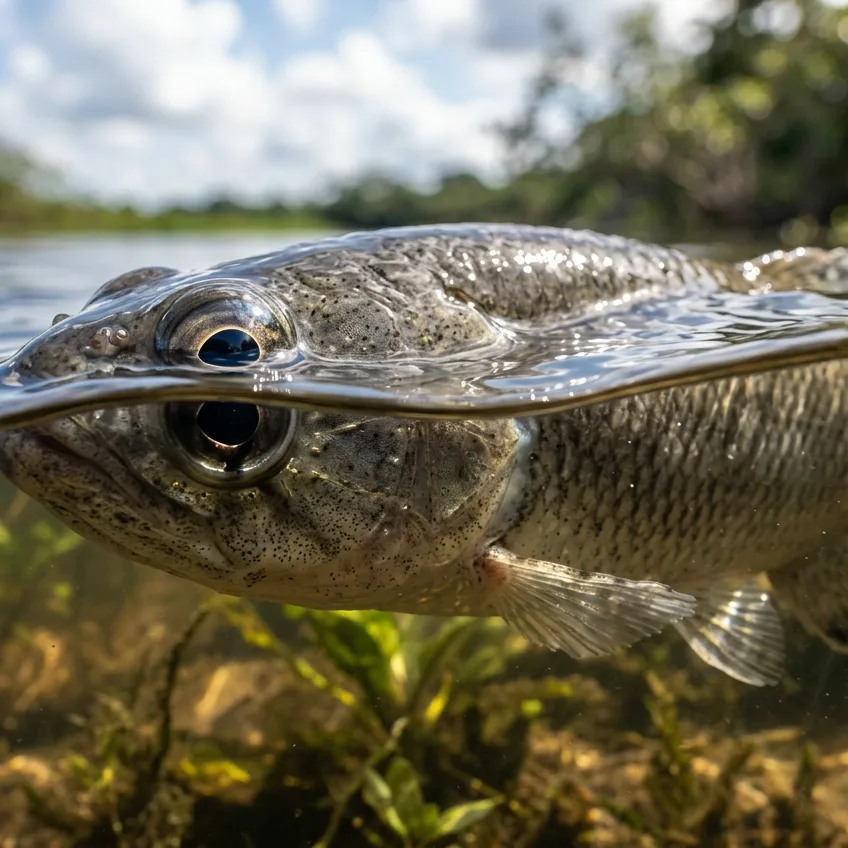
In the murky waters of mangroves and river estuaries across Central and South America lives a fish that solved one of evolution's greatest optical dilemmas: the Anableps anableps. Although popularly known as the "four-eyed fish," this animal has only two eyeballs, modified with unparalleled architectural precision.
To overcome the enormous difference between the refractive index of air and that of water, the eye anatomy of Anableps features unusual adaptations:
- Double pupils: Each eye is horizontally divided by an opaque band of connective tissue, creating two independent pupillary openings in the same eyeball.
- Asymmetrical pear-shaped lens: The internal lens is neither spherical like that of typical fish nor flattened like that of terrestrial animals. Aerial light passes through the short axis of the lens to compensate for corneal refraction, while underwater light enters through the long, more curved axis, achieving perfect focus in both media at once.
- Divided retina: At the back of the eye, there are two distinct retinal zones, equipped with neuronal densities and photopigments independently calibrated for the light spectrum of the surface and the muddy bottom.
By swimming skimming the boundary of surface tension, Anableps anableps keeps the upper half of its eyes in the air and the lower half submerged. This mechanism of natural bifocal glasses allows it to watch simultaneously for birds of prey diving from the sky and predatory fish rising from the depths, all while searching for algae and insects along the waterline.
Source: Proceedings of the Royal Society B: Biological Sciences / University of Maryland (comparative optics studies on Anableps)