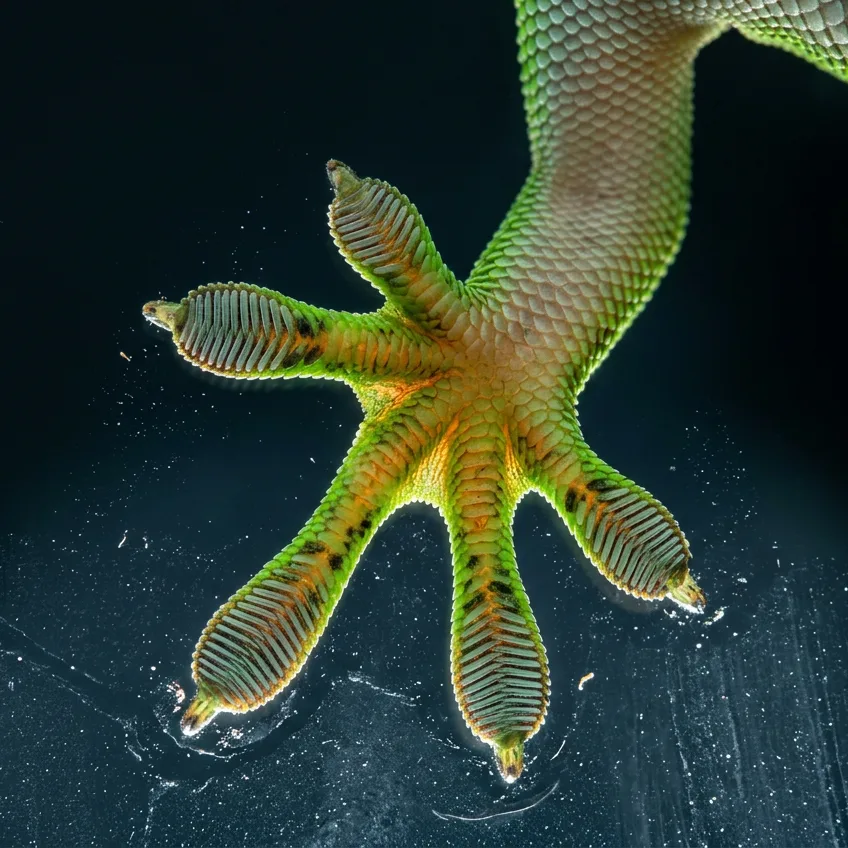
For centuries, the gecko's ability to scurry upside down on polished glass puzzled naturalists and engineers. It did not use suction cups, mechanical claws, or secrete adhesive substances. The answer to this biophysical enigma did not arrive until the beginning of the 21st century, when a team from the University of California, Berkeley demonstrated that these reptiles master molecular physics at the nanoscale thanks to Van der Waals forces.
The soles of a gecko's toes house an astonishing fractal structure composed of several levels:
- Microscopic setae: About half a million elastic keratin filaments cover each foot, roughly ten times thinner than a human hair.
- Nanometric spatulae: Each seta branches at its tip into between 100 and 1,000 tiny triangular tips barely 200 nanometers wide.
When the gecko places its feet on a surface, billions of these spatulae come into intimate contact with the irregularities of the material at distances under one nanometer. At that scale, fluctuations in electron clouds between the reptile's molecules and those of the substrate generate instantaneous electrodynamic attractions. Although each individual bond is weak, the collective sum of trillions of contact points creates a colossal force: the adhesive surface area of a single common gecko could, in theory, support a weight of more than 130 kilograms.
To detach effortlessly while running at more than one meter per second, the gecko simply modifies the angle of its toes to more than 30 degrees, unaligning the spatulae and breaking the molecular bond in milliseconds.
Source: Nature (Autumn et al., 'Adhesive force of a single gecko foot-hair' & 'Evidence for van der Waals adhesion in gecko setae')