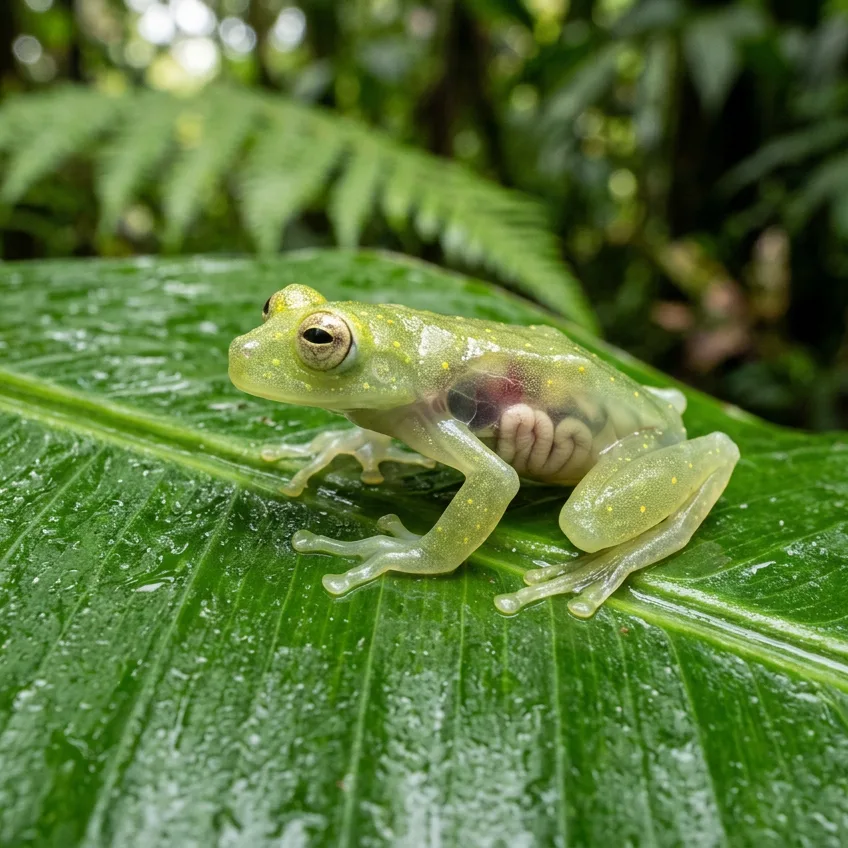
Beneath the dense vegetation of Central and South American rainforests lives the glassfrog (Hyalinobatrachium fleischmanni), a tiny nocturnal amphibian that holds a circulatory secret unmatched in the animal kingdom. While sleeping peacefully on the underside of leaves during the day, its body becomes almost entirely translucent, vanishing from the sight of predatory birds and snakes.
For decades, biologists wondered how it achieved such an optical feat when vertebrate blood is densely packed with hemoglobin, a dark red pigment that relentlessly absorbs light. In 2022, a multidisciplinary team of researchers from Duke University solved the puzzle in a study published in the journal Science: the frog actively hides its own blood.
Upon falling asleep, the frog removes up to 89% of its red blood cells from general circulation and packs them inside its liver. This organ features an outer coating of guanine nanocrystals that reflects light like a mirror, camouflaging the concentrated scarlet mass. Upon waking at night, the erythrocytes return to the bloodstream and the frog regains its usual opacity.
Most astonishing to science is not just the optics, but the hematological mystery: in any mammal, crowding red blood cells to such a density would trigger an instant, deadly thrombosis. The glassfrog performs this maneuver daily without generating clots or damaging its vessels, opening a promising avenue for the development of new human antithrombotic treatments.
Source: Science (American Association for the Advancement of Science) - Study 'Glassfrogs conceal erythrocytes in the liver to maintain transparency', 2022.