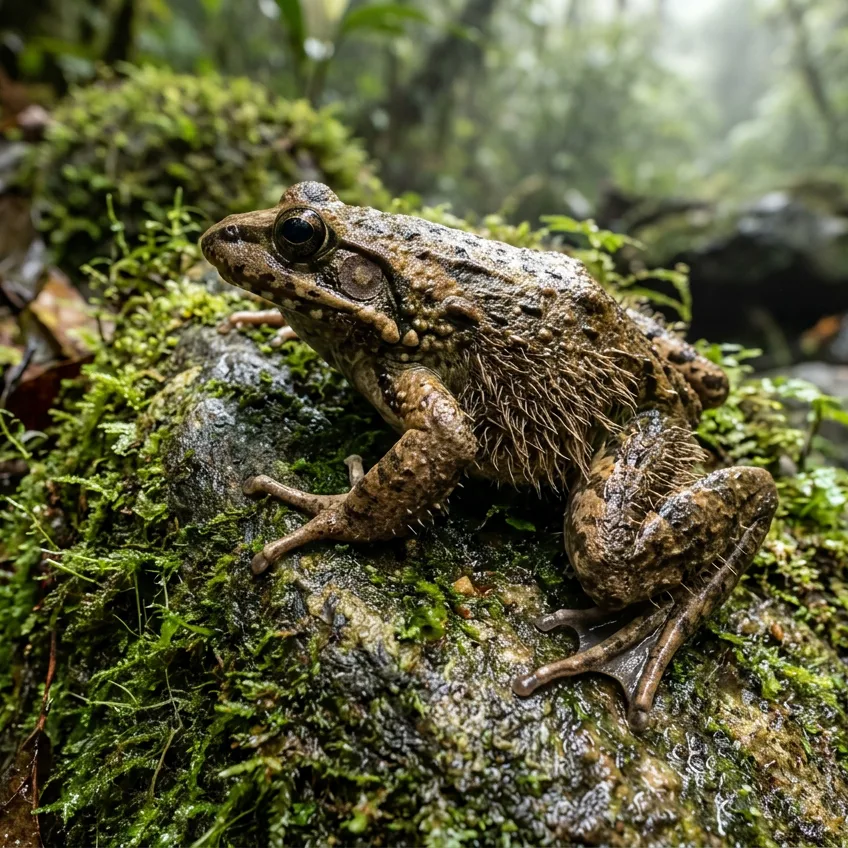
In the fast-flowing rivers of central Africa lives a vertebrate with one of biology's most puzzling anatomical defenses: the hairy frog (Trichobatrachus robustus). Although males are famous for displaying hair-like dermal filaments during the breeding season—heavily vascularized structures that increase oxygen absorption underwater—their most radical mechanism hides in the toes of their hind feet.
Unlike most animals, whose claws are made of keratin, this frog's claws are made of pure bone. At rest, these small sharp phalanges remain concealed inside the toe pads, connected to a bony nodule by a sturdy collagen ligament.
When the frog is captured or cornered, a powerful flexor muscle contracts so violently that it intentionally breaks the bond of the phalanx. The sharp tip of the bone cuts through the skin from the inside and emerges like a rigid dagger, ready to wound the predator's mouth or limbs.
Research led by Harvard University in 2008 confirmed that after the threat passes, the muscles relax and the bone passively retracts back inside the toe. Thanks to the remarkable regenerative capacity of amphibians, the skin wound heals and the collagenous connections fully repair, leaving the weapon ready for future combat.
Source: Blackburn, D. C. et al. (2008). 'Concealed claws in African frogs'. Biology Letters (The Royal Society).