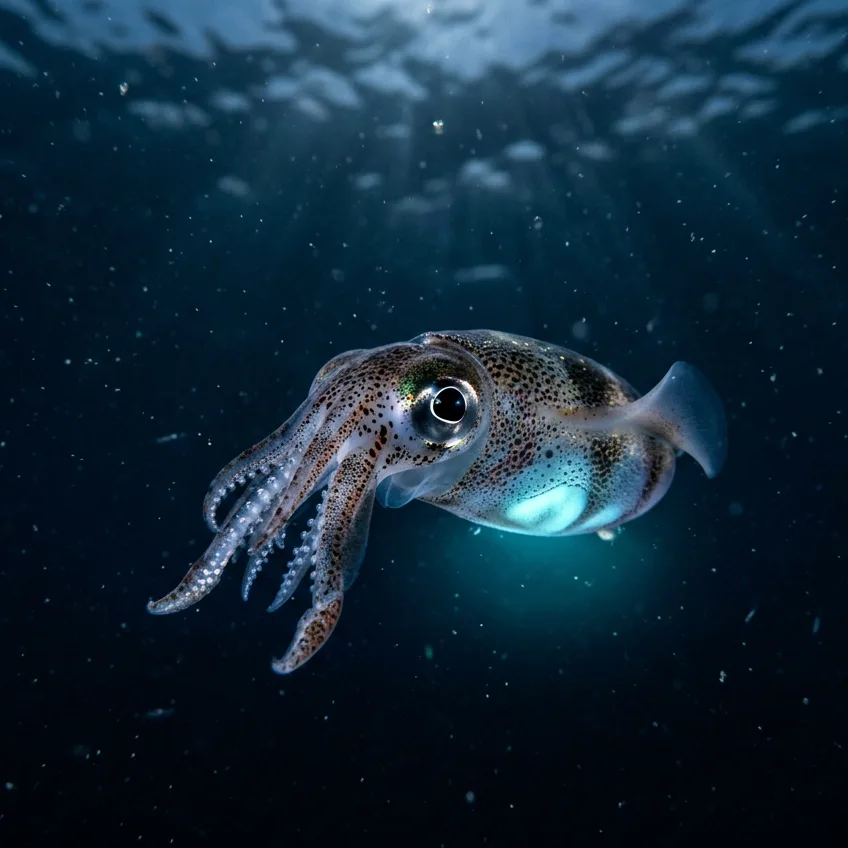
Beneath the shallow waters of Hawaiian reefs lives a tiny cephalopod barely three centimeters long, capable of one of the most sophisticated camouflage tricks on the planet: active counterillumination. The Hawaiian bobtail squid (Euprymna scolopes) spends the daylight hours buried under the sand, but when night falls it emerges to hunt in open water, leaving itself exposed to large predators patrolling the seabed looking for silhouettes cast against the surface by the moon and stars.
To avoid casting any shadow that would give away its position, this mollusk hosts a specialized light organ inside its body colonized by the marine bacterium Vibrio fischeri. Through photoreceptors located in its eyes and within the mantle cavity itself, the squid measures the intensity of downwelling light with mathematical precision. It then mechanically adjusts its brightness using ink sacs as diaphragms and epithelial tissues that act as diffusing lenses, emitting downward the exact same amount of light it receives from above.
The resulting visual effect is flawless: the light from its belly cancels out its silhouette in the water, making it completely invisible to any predator looking toward the surface. Furthermore, this symbiotic pact follows a strict circadian rhythm. Every dawn, when the squid buries itself to sleep, it expels 95 % of its bacteria into the ocean to avoid wasting nutrients maintaining them, allowing the remaining small colony to multiply during the day to be ready before the next night of hunting.
Source: Proceedings of the National Academy of Sciences (PNAS) / Margaret McFall-Ngai Lab