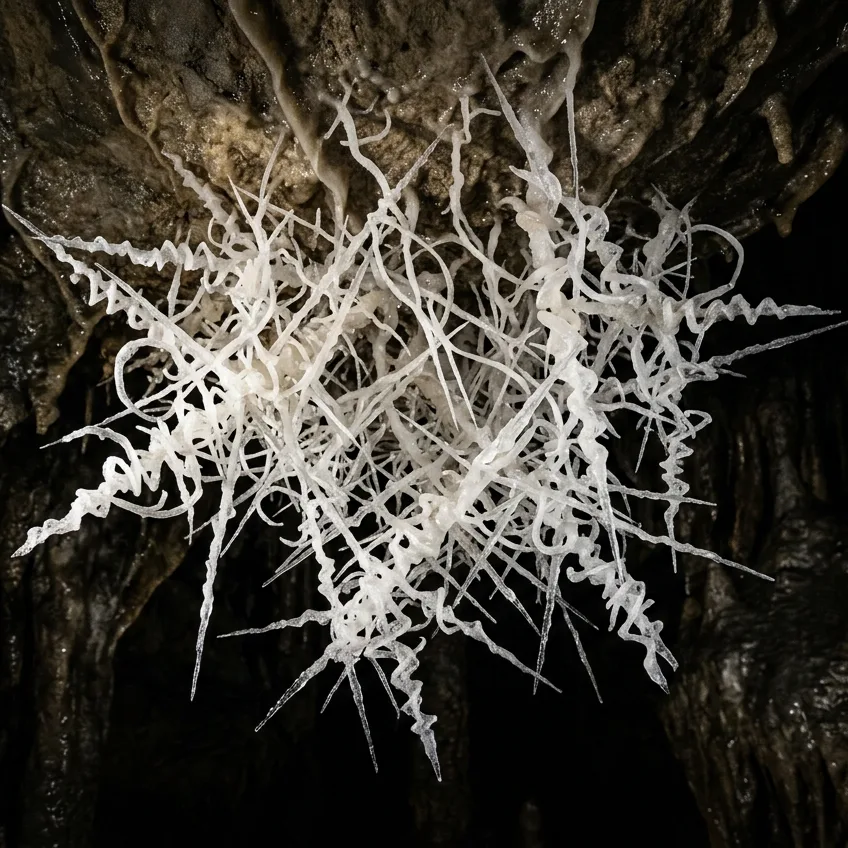
Inside karst caves, gravity usually imposes an unquestionable rule: stalactites hang straight down from the ceiling and stalagmites rise vertically from the floor. However, there is an unusual geological exception that seems to violate all the rules of classical physics: helictites, speleothems that grow in any imaginable direction, twisting in spirals, right angles, and even climbing toward the ceiling like tangled crystal branches.
The secret of this mineral dance lies in a battle of microscopic forces. Helictites do not form from freely falling drops, but through a tiny central capillary canal, with a diameter measuring just a fraction of a millimeter. At that scale, surface tension and the capillarity of water exert a hydrostatic pressure far more powerful than the planet's gravitational pull.
The process occurs at an excruciatingly slow pace:
- Water loaded with calcium bicarbonate is forced through the microconduit by constant hydrostatic pressure.
- Upon reaching the tip of the filament, the water comes into contact with the cave air, releasing carbon dioxide and precipitating calcite or aragonite.
- The orientation of the mineral's crystal faces and microscopic variations in flow continually deflect the direction of the water outlet.
The result is branching filaments that take tens of thousands of years to complete. A minimal air draft or a tiny variation in ambient humidity is enough to make the crystal turn sharply in space, creating geological sculptures so complex they look like biological organisms petrified in absolute darkness.
Source: Cave Minerals of the World (Hill & Forti) / National Speleological Society