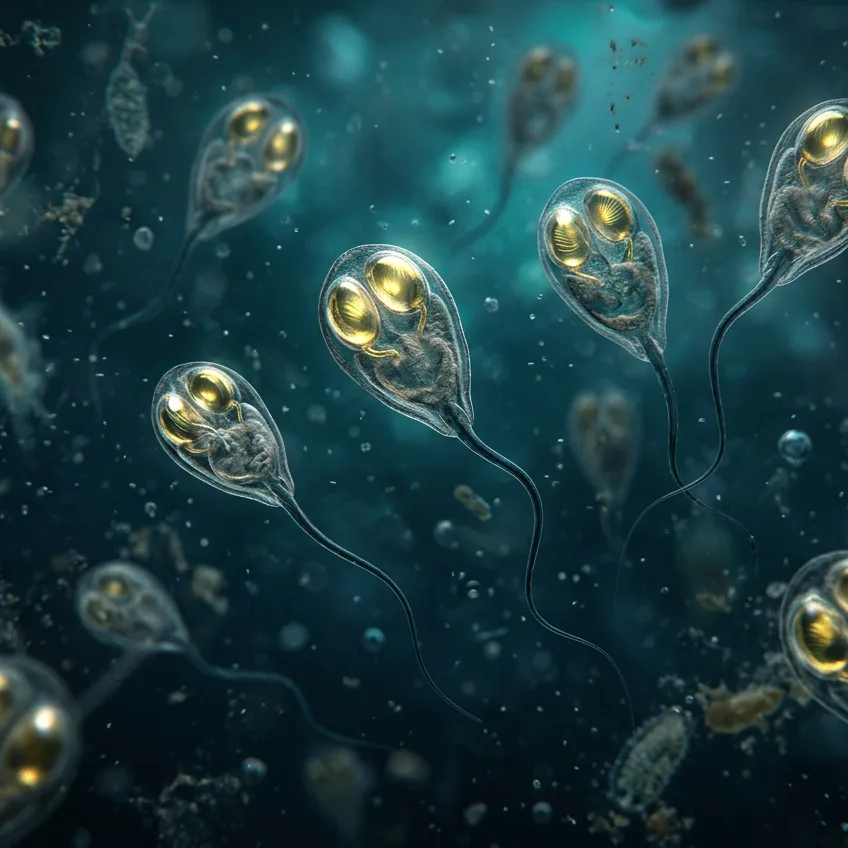
Until recently, biology textbooks established an immutable universal dogma: all multicellular animals need oxygen to generate cellular energy through their mitochondria. However, in 2020, a team of researchers from Tel Aviv University published a finding in the journal PNAS that dismantled that certainty: Henneguya salminicola, a tiny parasite belonging to the cnidarian phylum (the same lineage as jellyfish and corals), does not breathe at all.
Upon sequencing its complete genome, scientists discovered with astonishment that this creature has not only lost the metabolic ability to carry out aerobic respiration, but also completely lacks mitochondrial DNA. Although it retains vestigial organelles derived from ancient mitochondria, it has eliminated all the genes necessary to consume oxygen and synthesize chemical energy through the usual electron transport chain.
This organism, which lives in the muscle tissue of wild salmon, chose an unusual evolutionary path:
- Extreme genomic reduction: It discarded the mitochondrial genome to simplify its metabolism in muscular environments devoid of free oxygen.
- Total energy dependence: It directly hijacks energy molecules already processed by the host fish, behaving as an ultra-specialized parasite.
- Alien microscopic structure: Its spores feature two polar capsules resembling hollow eyes, which are actually cellular harpoons used to attach to tissue.
The discovery of Henneguya salminicola not only forced a redefinition of the indispensable requirements for being an animal, but also proved that evolution can dispense with respiration to thrive on Earth.
Source: Proceedings of the National Academy of Sciences (PNAS), Yahalomi et al. (2020)