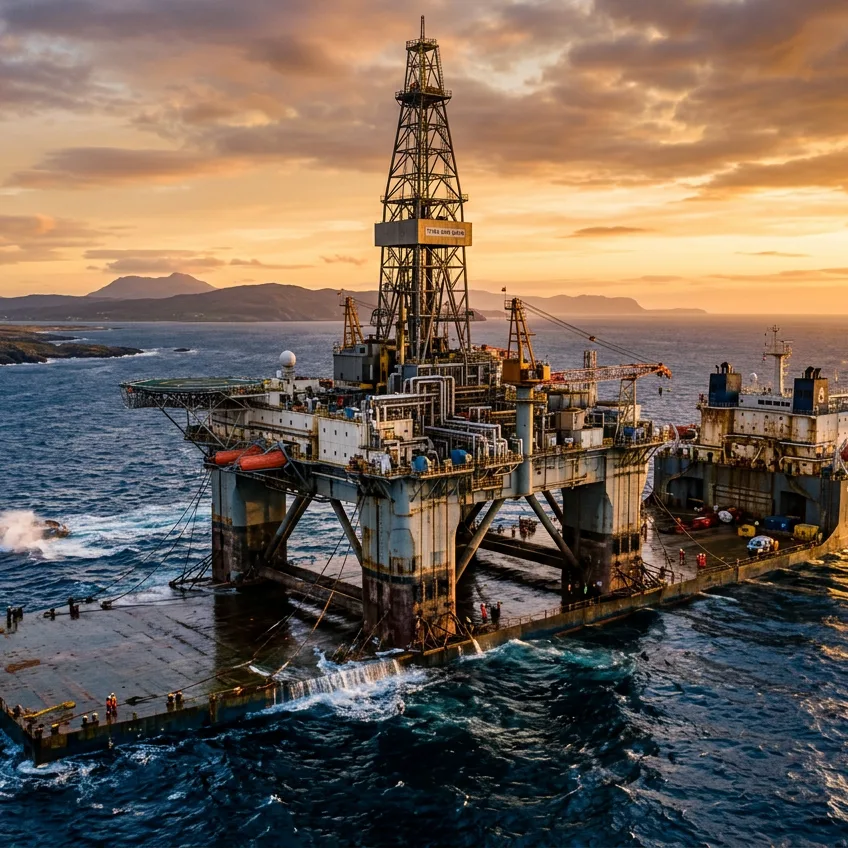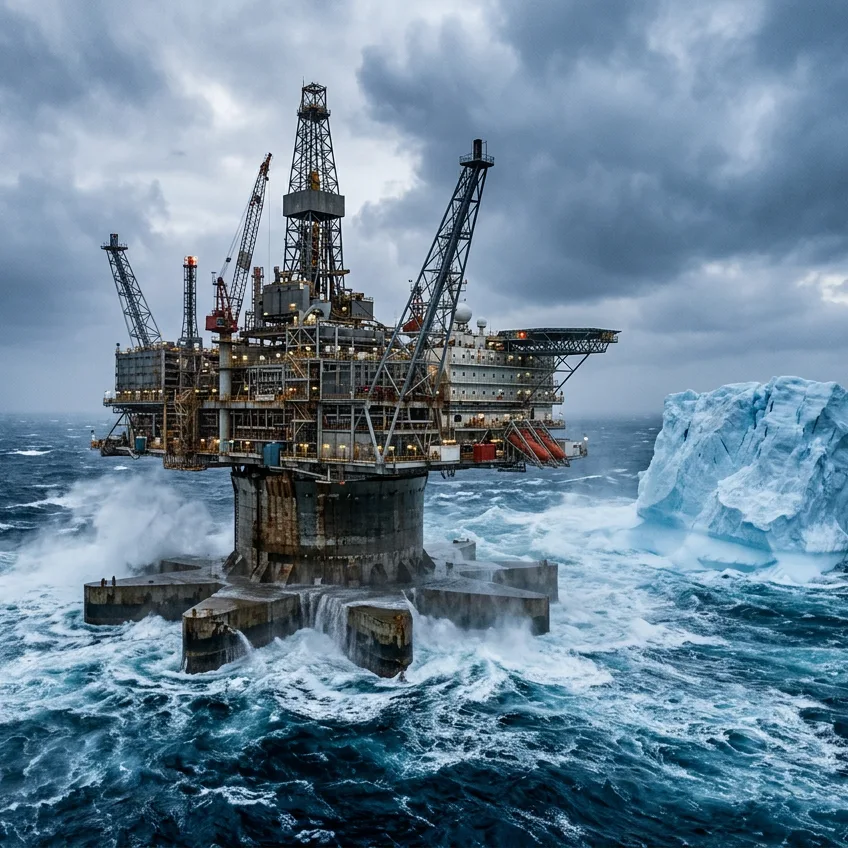
In the frigid waters of the Grand Banks of Newfoundland, in the very maritime corridor where the Titanic met its fatal fate, operates one of the greatest feats of modern ocean engineering: the Hibernia oil platform. In this sector, known as Iceberg Alley, ice masses weighing several million tons drift, carried by the Labrador Current. While most floating offshore platforms must decouple and retreat in the face of an impending collision, Hibernia was built under a defiant premise: stand still and take the hit head-on.
The secret to its invulnerability lies in its colossal gravity-based structure (GBS). This base is not a simple support cylinder, but a reinforced concrete bunker featuring a sixteen-point toothed outer wall. With walls up to 1.4 meters thick made of ultra-high-strength concrete, these wedge-shaped edges concentrate immense physical pressure onto a tiny area at the moment of contact. In this way, the toothed shield shatters and pulverizes the iceberg's core before kinetic energy can destabilize the tower.
To prevent such a massive force from dislodging it from the seabed at a depth of 80 meters, the base's internal cavities were ballasted with water and dense iron ore gravel, reaching an astronomical weight of 1.2 million tons anchored to the North Atlantic floor. Since its commissioning in 1997, this titan of engineering has not only weathered storms with thirty-meter waves, but has also turned the planet's most dangerous ice into mere crushed snow.
Source: Doris Engineering / Offshore Technology - Hibernia Platform Structural Design Records