Liquid water is almost eight hundred times denser than air. Due to this basic physical reason, any submerged moving body experiences massive viscous drag that historically limited the speed of conventional submersibles and torpedoes to just over seventy or eighty kilometers per hour. However, fluid physics discovered an astonishing loophole: supercavitation.
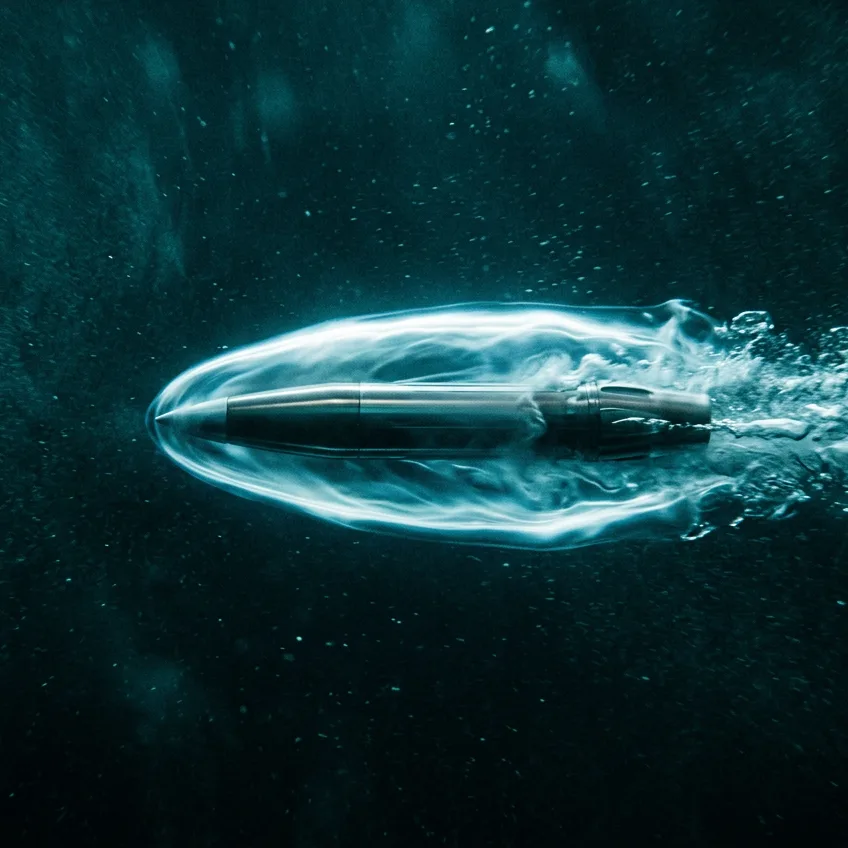
This phenomenon is triggered when an object's speed in water causes the local pressure at its nose to drop drastically below the fluid's vapor pressure. At that exact moment, water boils spontaneously at room temperature, turning into vapor. If the tip is designed with a sharp, flat geometry—called a cavitator—and combustion gases are injected into it, that cavity expands longitudinally to form a giant bubble that completely envelops the vehicle's hull.
The result is astonishing: the projectile stops rubbing against dense water and moves inside a gas sheath, reducing hydrodynamic friction by up to ninety percent. Thanks to this principle, Soviet engineers in the 1970s designed the VA-111 Shkval torpedo, powered by a solid-fuel rocket that reached more than 370 kilometers per hour (200 knots) deep underwater.
The greatest technical challenge lies in maneuverability: because it does not touch the liquid, traditional rudders are useless inside the bubble's void, forcing the use of thrust vectoring and specialized fins that graze the boundary between gas and water with millimeter precision.
Source: Journal of Fluid Mechanics / Office of Naval Research