In the popular imagination, ice is synonymous with subzero temperatures. However, water physics is much more complex: depending on pressure and temperature, there are nearly twenty different crystalline phases. Until March 2018, one of the most extreme, known as Ice-VII, had only been created fleetingly in high-energy laboratories using lasers and diamond anvil cells. Everything changed when an international team of geologists analyzed gems mined from deep deposits in Botswana and South Africa.
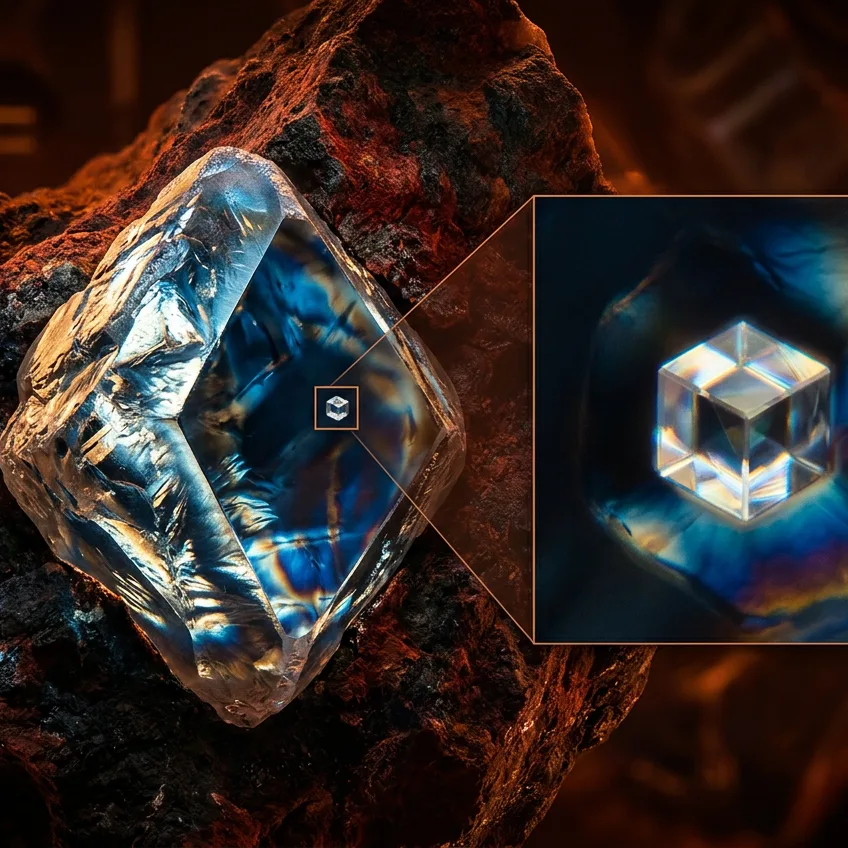
By examining diamonds formed at more than 600 kilometers depth—right in Earth's mantle transition zone—using synchrotron X-ray diffraction, scientists discovered tiny inclusions containing natural Ice-VII. During their violent ascent toward the crust, the diamond acted as an indestructible pressure capsule. As the surrounding rock cooled, the water trapped inside could neither expand nor relax due to the extreme rigidity of the carbon lattice, maintaining internal pressures exceeding 24,000 bars (about 24,000 times Earth's atmospheric pressure).
Under that titanic compression, H₂O molecules rearrange into a dense three-dimensional cubic structure that remains solid even at hundreds of degrees Celsius. This finding not only confirmed Ice-VII as an official mineral recognized by the International Mineralogical Association, but also provided the first direct, irrefutable evidence that fluid currents and rich aqueous reservoirs exist in unexpectedly deep regions of Earth's mantle.
Source: Science (Tschauner et al., 2018: 'Ice-VII inclusions in diamonds: Evidence for aqueous fluid in Earth’s deep mantle')