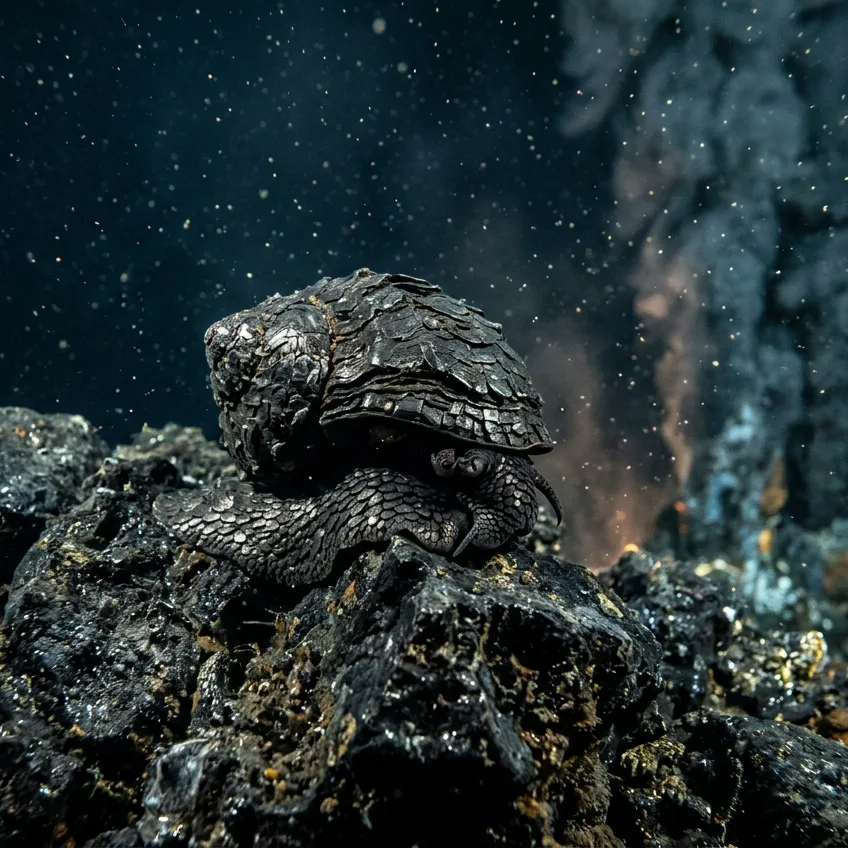
In the depths of the Indian Ocean, more than 2,400 meters below the surface and beside hydrothermal vents spewing fluids loaded with heavy metals at more than 300 °C, lives one of the planet's most extreme creatures: the gastropod Chrysomallon squamiferum, popularly known as the scaly-foot snail or iron-armored snail.
Discovered in 2001 in the Kairei hydrothermal field, this mollusk holds an absolute evolutionary record: it is the only known animal that incorporates iron sulfide compounds directly into its exoskeleton and scales. Its shell features a sophisticated three-layer architecture designed to withstand both predator crushing and brutal thermal shifts:
- Outer sulfide layer: Made of greigite and pyrite, magnetic iron nanoparticles that deflect cracks and absorb mechanical shocks.
- Middle organic layer: A thick, spongy conchiolin matrix that cushions energy and prevents puncture from crab claws.
- Inner mineral layer: A rigid aragonite base common in other mollusks that hermetically seals its organs.
Unlike other snails, its foot does not retract behind an operculum; instead, it is covered by hundreds of sclerotized scales reinforced with iron sulfide, resembling medieval chainmail. In addition, the snail does not need to hunt: it hosts endosymbiotic bacteria in its esophagus that synthesize nutrients by oxidizing sulfides from abyssal water.
Source: National Geographic / Proceedings of the National Academy of Sciences (PNAS)