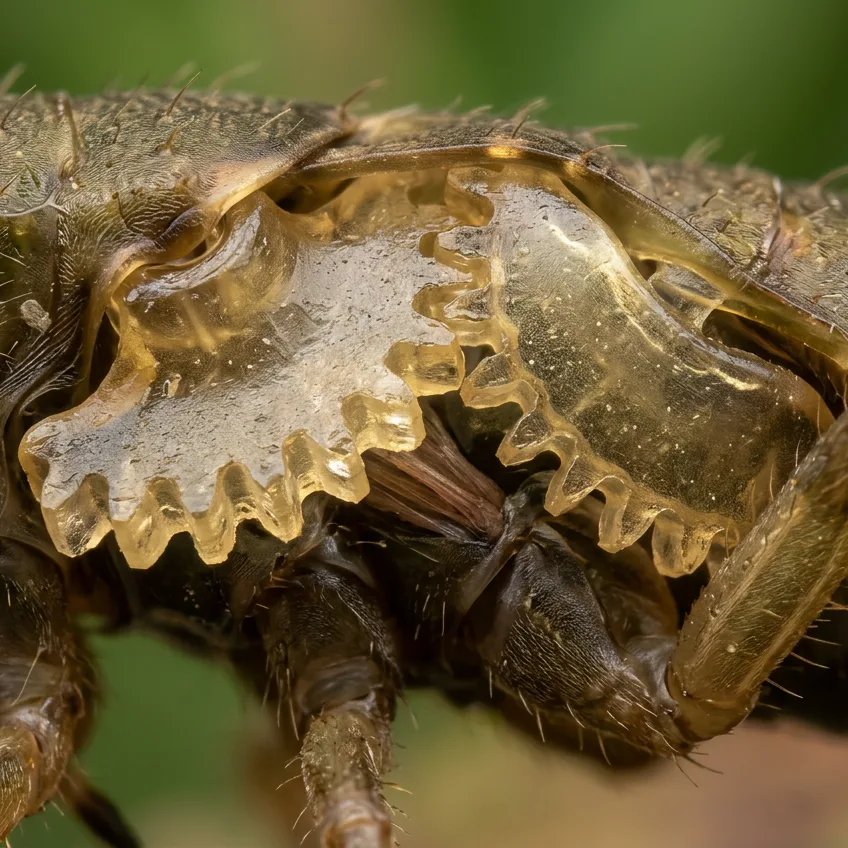
Until very recently, humanity believed that the invention of mechanical toothed gears was an achievement exclusive to human technology. However, in 2013, researchers Malcolm Burrows and Gregory Sutton, from the University of Cambridge, discovered that nature had beaten us by millions of years in the nymph of Issus coleoptratus, a small jumping insect just a few millimeters long common in European gardens.
Located on the hind joints (on the trochanters of its legs), this insect has two curved opposing strips with ten to twelve perfectly carved teeth. Each tooth measures barely tens of micrometers and fits with millimeter precision into the space of the opposite one, exactly like the gears of a Swiss watch or a car's gearbox.
Its function is crucial for survival:
- Extreme synchronization: When jumping, both hind legs must fire in near-absolute unison. The animal nervous impulse is too slow to coordinate both sides independently; the gears ensure that both legs move with a delay of less than 30 microseconds.
- Aerodynamic stability: Without this physical mechanical coupling, a minimal difference in thrust would cause the insect to spin in an uncontrolled spiral instead of being propelled in a straight line.
Curiously, only nymphs retain these gear teeth. In the final molt into the adult stage, the gears disappear and are replaced by a friction system, since if a tooth were to break in adulthood, the insect would not be able to molt again to regenerate it.
Source: Science (Burrows & Sutton, 2013 - 'Interacting Gears Synchronize Propulsive Leg Movements in a Jumping Insect')