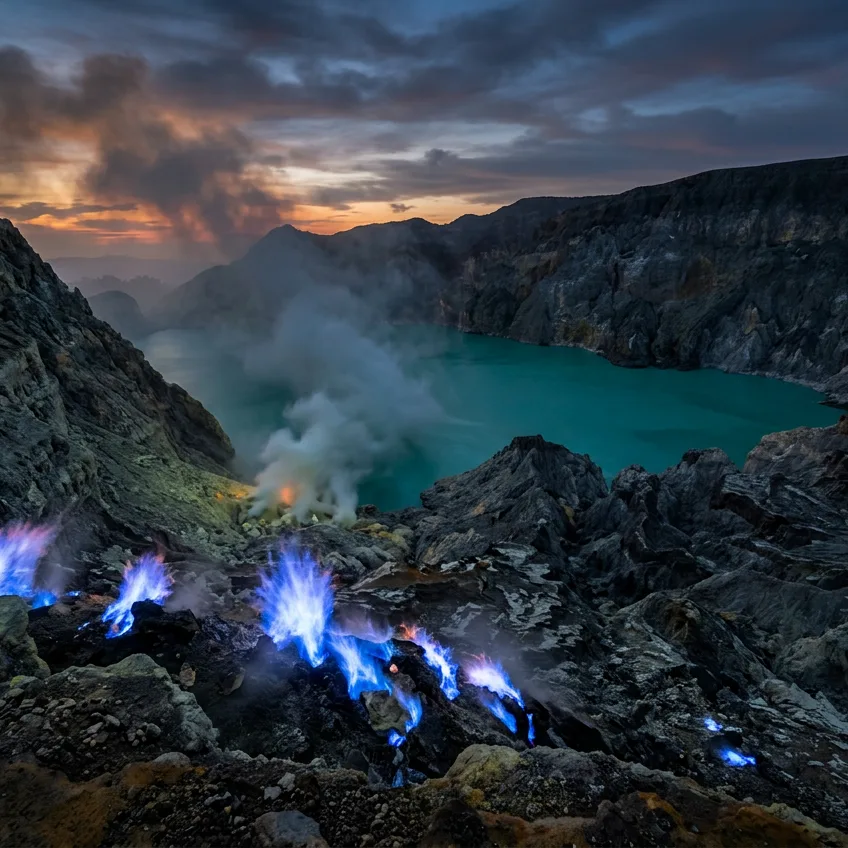
In eastern Java stands Kawah Ijen, a geological wonder famous for a phenomenon that seems from another planet: the sighting of what is popularly known as "blue lava." In reality, it is not magma with a strange composition, but a violent combustion of sulfuric gases expelled under high pressure at temperatures exceeding 600 °C.
Upon emerging through volcanic cracks and coming into contact with oxygen in the air, these sulfur gases immediately ignite into flames of a vibrant cobalt blue hue, visible only at nightfall. Part of the condensed gas turns into burning liquid sulfur that flows down the rocky slopes, resembling rivers of blue fire that can reach up to five meters in height.
This volcanic complex also stands out for harboring in its crater one of the most extreme geochemical environments on the planet:
- The most acidic lake in the world: It has a flooded crater roughly one kilometer in diameter with more than 30 million cubic meters of turquoise water whose pH ranges between 0.1 and 0.5, a concentration similar to battery acid due to its saturation of sulfuric and hydrochloric acid.
- Extreme artisanal mining: Local miners manually extract solid sulfur blocks after cooling the vapors through ceramic pipes, carrying baskets weighing up to 80 kilograms without respiratory protection.
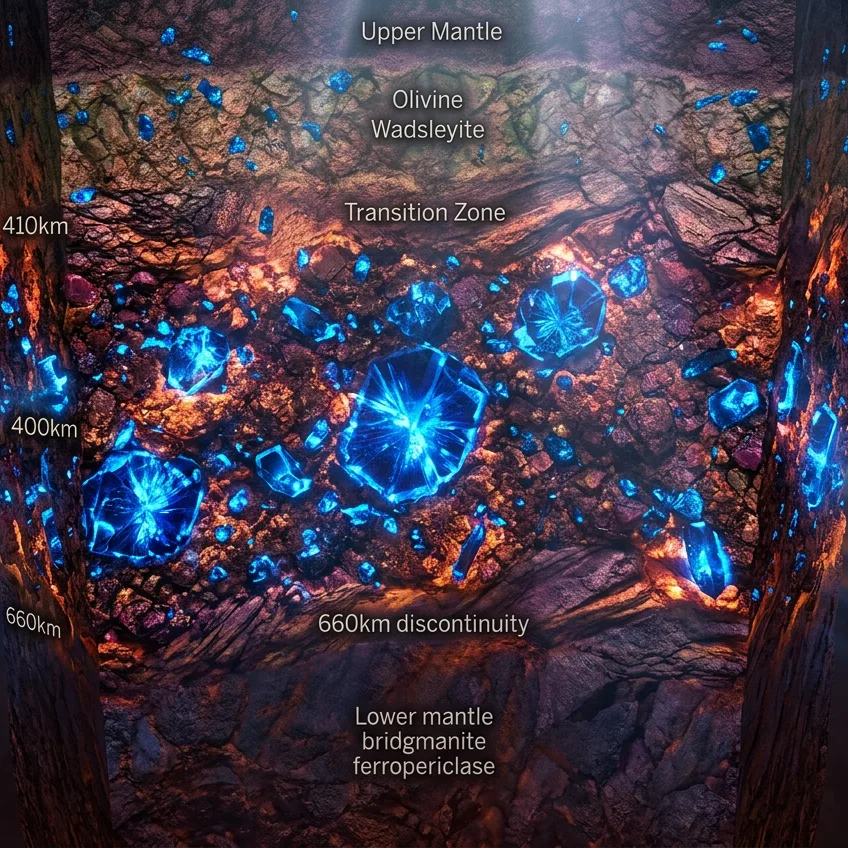
Kawah Ijen is an irreplaceable natural laboratory where the interaction between deep hydrothermal fluids and the atmosphere reveals the intense chemical activity of Earth's mantle.
Source: Smithsonian Institution - Global Volcanism Program (Kawah Ijen)