In popular culture and heavy industry, lasers are synonymous with concentrated heat, welding, and thermal cutting. However, in cutting-edge quantum physics they are used for the opposite purpose: reaching the coldest temperatures ever recorded in the cosmos.
This technique, formally known as Doppler cooling, takes advantage of the tiny mechanical kick of linear momentum that photons transfer to atoms. The temperature of a gas is simply the direct measurement of the chaotic speed at which its particles move; therefore, to cool it drastically, one simply needs to bring that movement to an abrupt halt.
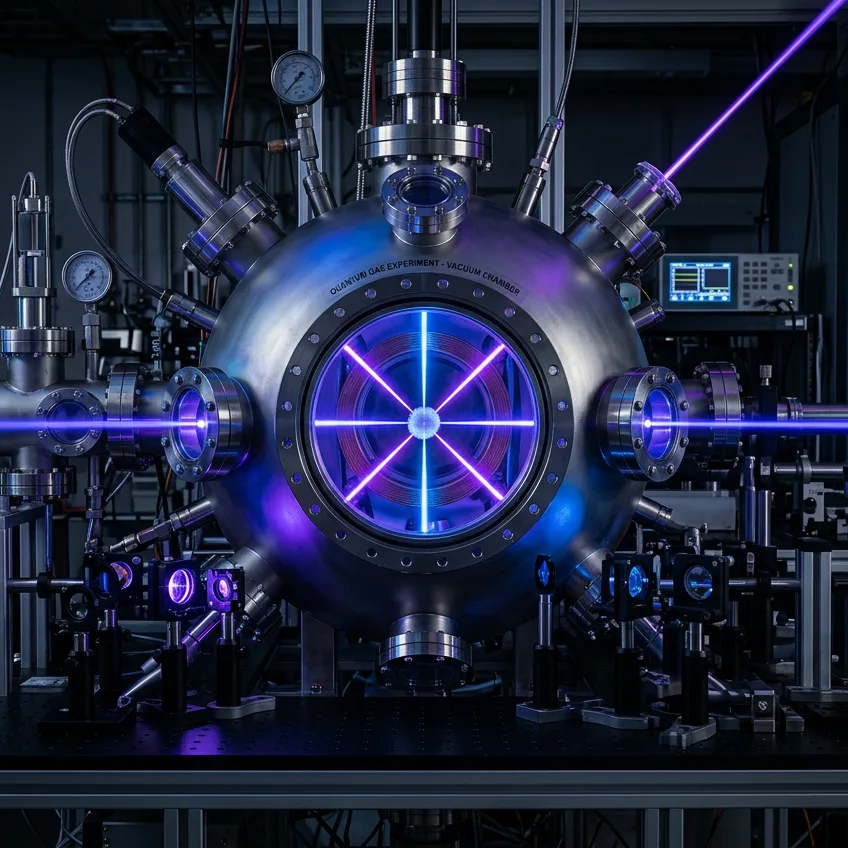
To achieve this, physicists fire laser beams from six opposing directions, tuned to a frequency slightly below what the atom needs to absorb light. Thanks to the Doppler effect, only atoms traveling toward the beam perceive the right frequency to absorb the incoming photon. Upon receiving the head-on impact, the atom experiences a microscopic braking push, a process that repeats millions of times per second and creates an environment known as "optical molasses."
This technological feat allows atoms traveling at thousands of kilometers per hour to be slowed down to a crawl of barely millimeters per second. The result is the cooling of matter to a few microkelvins, skimming absolute zero (-273.15 °C), a cold infinitely more extreme than that of interstellar space. Developed in the late 20th century and awarded the Nobel Prize in Physics in 1997, this method is now the essential foundation for ultra-precise atomic clocks and quantum computers.
Source: Royal Swedish Academy of Sciences / Nobel Prize in Physics 1997 (Steven Chu, Claude Cohen-Tannoudji, and William D. Phillips)