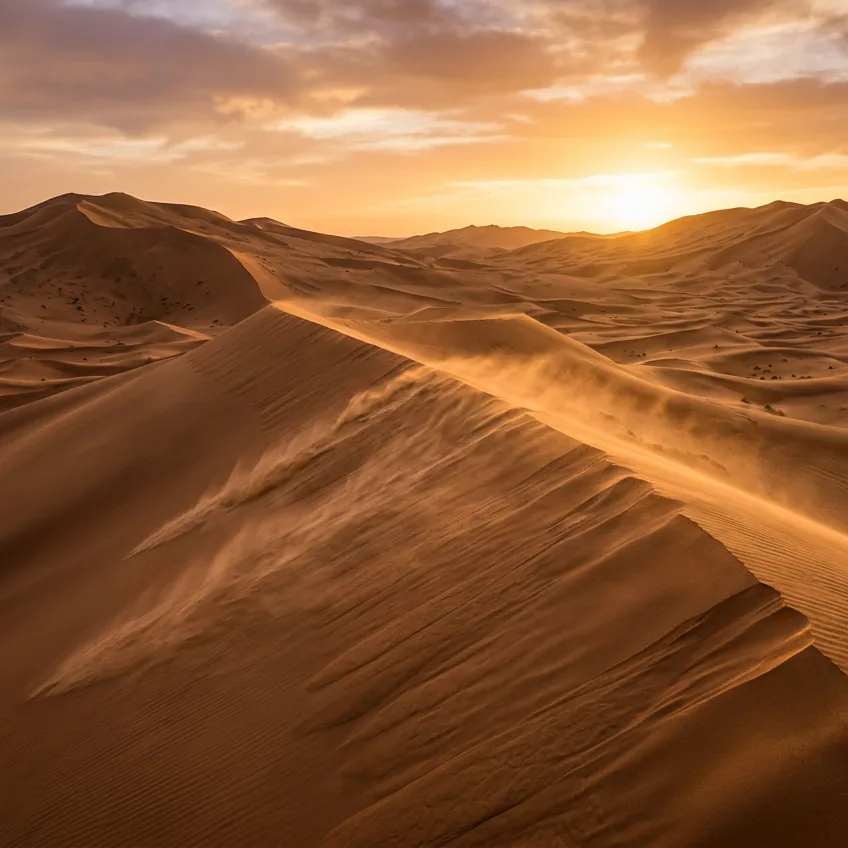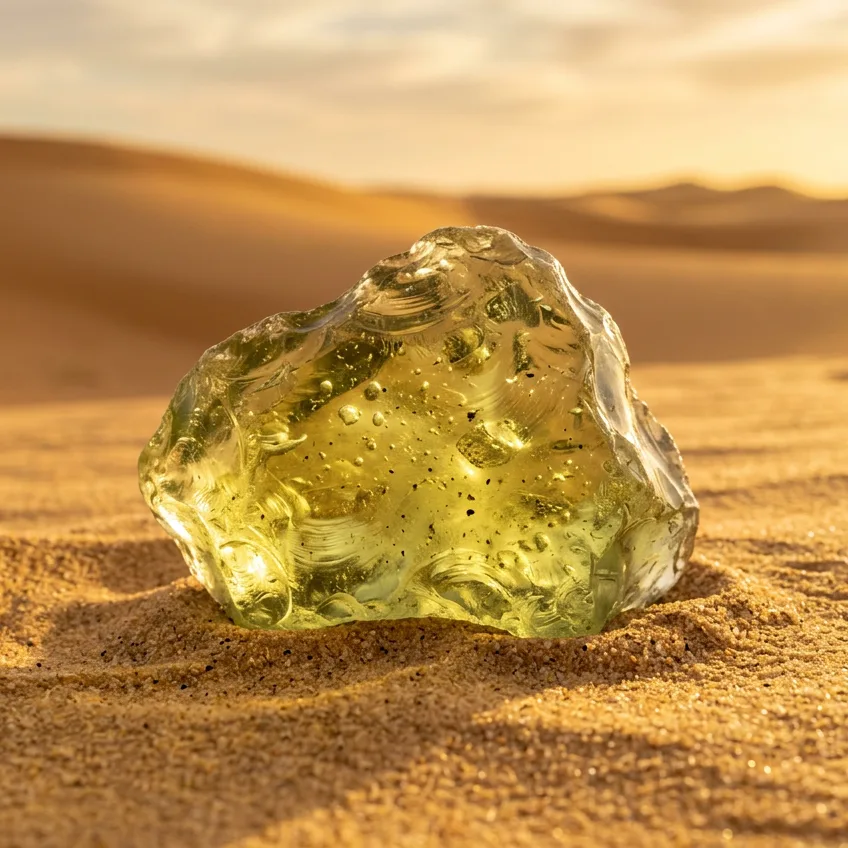
In the very heart of the Great Sand Sea, on the border between Egypt and Libya, lies one of the planet's most fascinating geological enigmas: Libyan desert glass. Across an area of dozens of square kilometers lie translucent, straw-yellow fragments composed of an extraordinary 98 % pure silica, a chemical purity practically unattainable through common terrestrial volcanism.
Since its scientific cataloging in 1932, its formation puzzled the geological community. Transforming quartz grains into such a dense, bubble-free glass requires brutal temperatures exceeding 1,600 °C, well above the limits of any conventional magma. The controversy was divided for decades between the hypothesis of a direct meteorite collision and the thermal airburst of an asteroid disintegrating in the lower atmosphere.
The definitive answer arrived upon analyzing microscopic zircons embedded in the samples. Geologists discovered traces of reidite, a mineral polymorph that only crystallizes under colossal pressures of at least 12 gigapascals and thermal peaks of up to 2,250 °C. This finding proved the inescapable presence of a hypervelocity shock wave caused by a violent cosmic impact that occurred about 29 million years ago.
Fascination with this material transcends geology: in 1999, gemological analyses confirmed that the central scarab of Pharaoh Tutankhamun's ceremonial pectoral was not chalcedony, but a piece carved from this unusual glass born from the collision of a space bolide with desert sands.
Source: Geology (Geological Society of America) / Natural History Museum