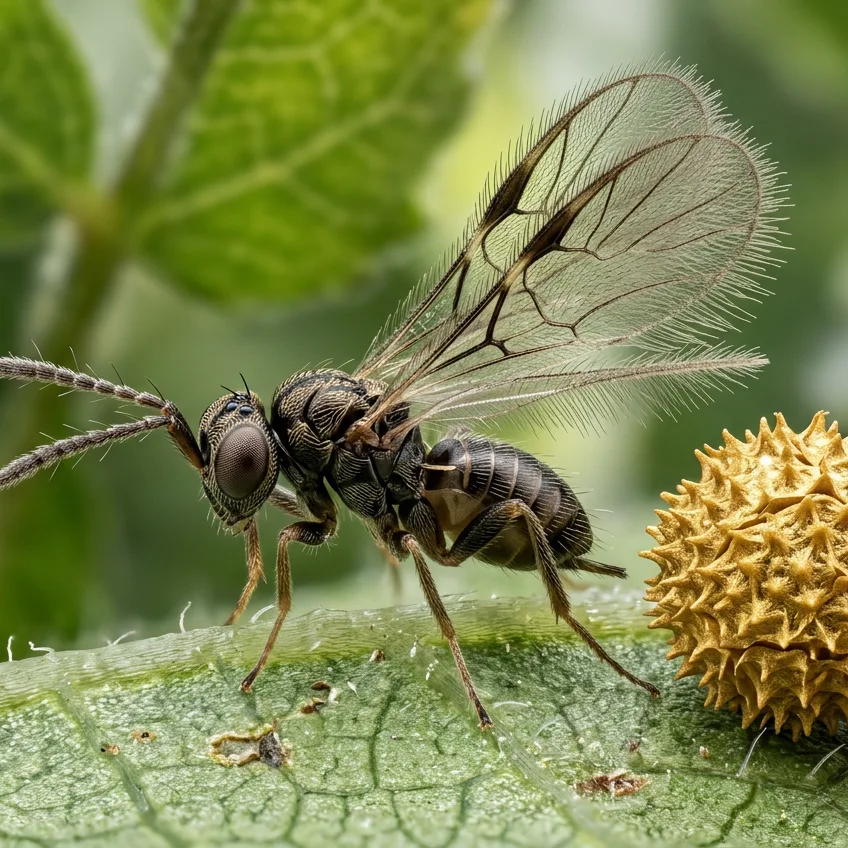
With an approximate length of 200 micrometers, the parasitoid wasp Megaphragma mymaripenne is smaller than several single-celled organisms, including the paramecium and certain amoebas. However, despite rivaling a grain of dust in volume, it has feathery wings, compound eyes, jointed legs, and a nervous system capable of flying, navigating, and locating hosts. The answer to how a complex brain fits into a biologically impossible space was discovered in 2012 by entomologist Alexey Polilov.
The fundamental bottleneck in any animal's miniaturization is the rigid size of cells, particularly the cell nucleus, which holds the genome. Because eukaryotic neurons require a minimum volume to house their nucleus, the wasp's head lacked enough room to hold the thousands of cells necessary to coordinate flight.
This insect's evolutionary solution was drastic: selective neuronal anucleation. During the final pupal stage, once the brain has established all of its synaptic connections, the organism triggers massive lysis in which about 95% of its more than 7,400 neurons destroy and degrade their own nuclei. The adult insect emerges with a nervous system composed almost entirely of functional cellular 'ghosts': anucleate cell bodies and axons that still conduct electrical impulses.
Without genetic machinery to renew proteins, these neurons cannot repair themselves, so the wasp lives for only about five days as an adult. That brief window is enough to mate and lay its eggs, showing an extreme limit in the flexibility of animal neurobiology.
Source: Polilov, A. A. (2012). The smallest insects evolve anucleate neurons. Arthropod Structure & Development, 41(1), 29-34.