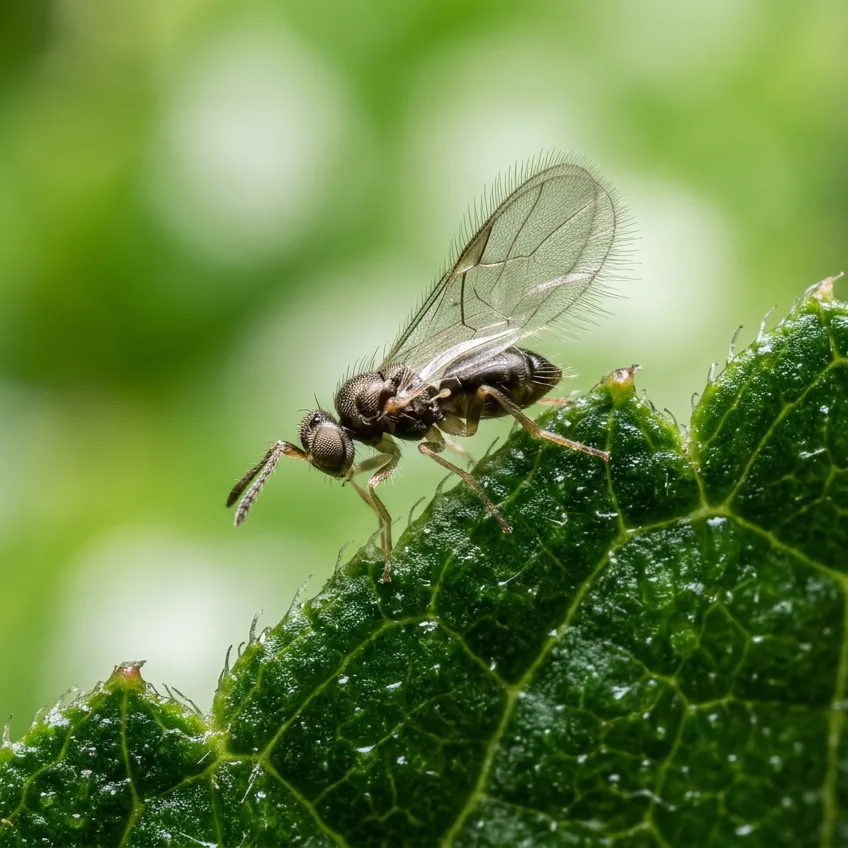
In the animal kingdom, shrinking body size imposes an impassable physiological hurdle: the minimum volume occupied by neurons to keep brain circuits alive. However, the parasitoid wasp Megaphragma mymaripenne, measuring about 200 micrometers (smaller than many single-celled organisms like the paramecium), solved this limitation through an unusual sacrifice: the massive, programmed enucleation of its central nervous system.
Discovered in detail by entomologist Alexey Polilov in 2012, this insect undergoes an unprecedented brain metamorphosis. During the pupal stage, its brain develops with about 7,400 ordinary, nucleated neurons. However, just days before emerging into the adult stage, 95% of its brain cells destroy and absorb their own cell nucleus along with their genetic material.
By getting rid of cell nuclei, brain volume drops colossally without dismantling the complex network of neuronal connections. The functional result is fascinating:
- Flight and navigation capability: Despite possessing barely 350 nucleated neurons in the adult stage, the wasp retains fully operational compound eyes, flies, and successfully locates thrips eggs to parasitize.
- Brief yet self-sufficient life: Since anucleated neurons cannot synthesize new proteins or repair themselves, the adult lives for only about five days, enough time to fulfill its reproductive mission.
This adaptation shatters the conventions of neurobiology by showing that a complex brain circuit can process sensory stimuli and coordinate motor movements while dispensing almost entirely with cellular DNA support.
Source: Arthropod Structure & Development (Alexey Polilov, 2012); Current Biology