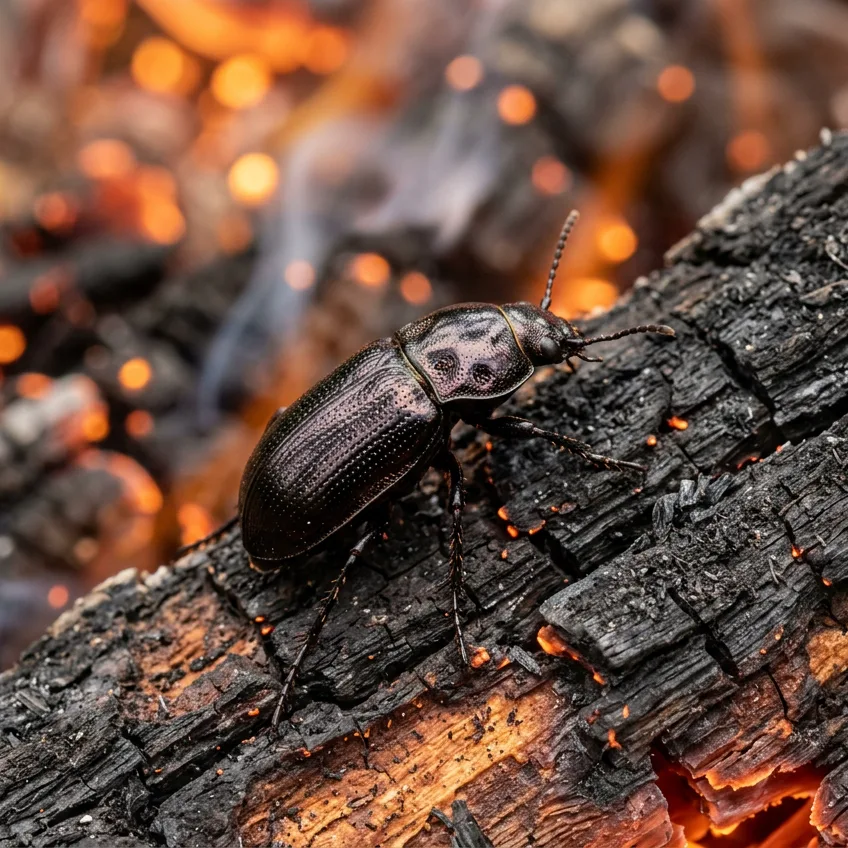
While practically every animal flees in terror from an advancing forest fire, the black fire beetle (Melanophila acuminata) takes flight straight toward the heart of the flames. Barely 1 centimeter long, this insect is strictly pyrophilous: it needs freshly scorched wood to mate and lay its eggs, since charred trees have lost their defensive chemical resins and their natural predators are gone.
To locate burning hot spots at distances of up to 100 kilometers, it relies neither on visible smoke nor traditional eyesight, but rather on one of nature's most sophisticated sensory systems: a pair of infrared organs on its thorax, just below its middle legs.
- Photomechanical mechanism: Each organ gathers dozens of microscopic receptors called sensilla, housing a hollow, fluid-filled cuticular sphere connected to a mechanoreceptor neuron.
- Thermal tuning: The cuticle precisely absorbs the infrared radiation emitted by glowing wood, within the 3 to 3.5 micrometer wavelength band.
- Instant expansion: Upon absorbing heat, the fluid expands immediately, raising internal hydrostatic pressure and compressing the nerve ending to send an electrical signal to the brain.
This evolutionary feat converts thermal electromagnetic radiation into a purely mechanical stimulus without requiring complex cellular cooling systems, inspiring aerospace bioengineering to design low-cost passive infrared detectors.
Source: Nature / Journal of Comparative Physiology A (studies on biomimetics and thermoreception by Helmut Schmitz)