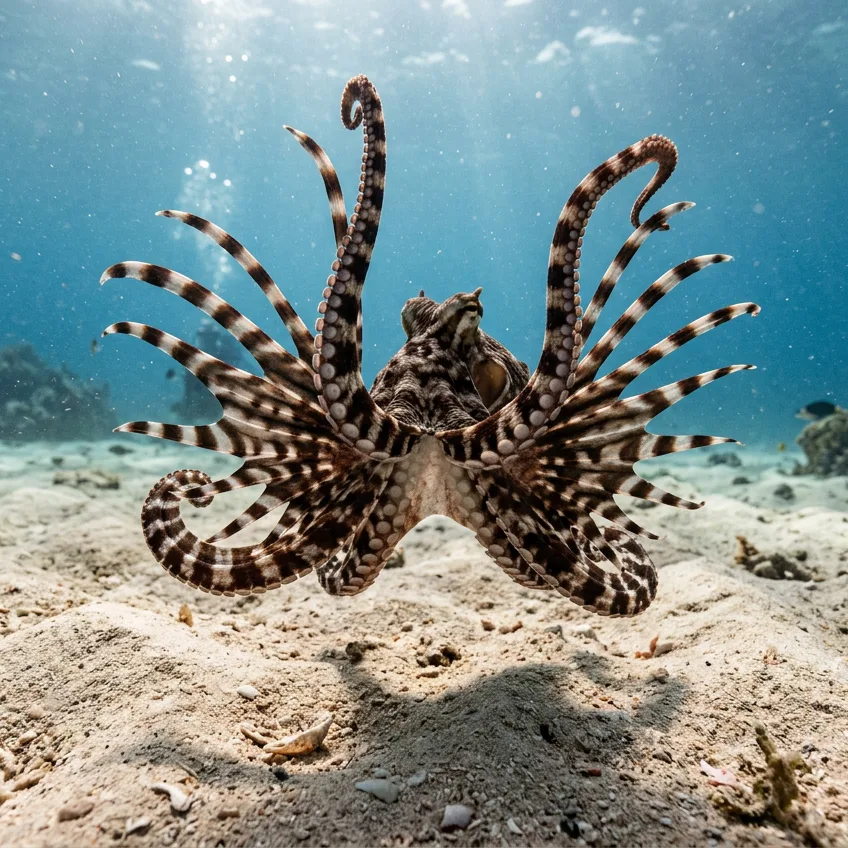
Unlike most octopuses, which rely on rocks and coral reefs to blend into their surroundings, the mimic octopus (Thaumoctopus mimicus) lives on open sandy bottoms and mudflats in Indonesia and the Great Barrier Reef, environments devoid of hiding places. Discovered by marine biologists in 1998, this invertebrate developed one of the most sophisticated survival strategies in the animal kingdom: dynamic facultative mimicry.
Instead of merely matching the substrate's shade through its chromatophores, Thaumoctopus mimicus voluntarily alters its silhouette, body posture, and locomotive pattern to accurately impersonate more than fifteen different aquatic species, the vast majority of which are toxic or dangerous to its attackers:
- Lionfish (Pterois): spreads its eight tentacles outward, keeping them rigid and striped while moving slowly, simulating venomous dorsal spines.
- Banded sea snake: hides six of its limbs inside a sandy burrow and extends the remaining two arms in opposite directions, undulating them with black and white patterns.
- Venomous sole: fully folds all tentacles backward and propels itself along the bottom with a flat, undulating swimming motion that replicates the shape of a toxic flatfish.
Most fascinating for ethology is its capacity for contextual decision-making. If a territorial damselfish harasses it, the octopus does not choose a disguise at random: it immediately takes the form of a sea snake, the most feared natural predator of that species.
Source: Norman, M. D., Finn, J., & Tregenza, T. (2001). Dynamic mimicry in an Indo-Malayan octopus. Proceedings of the Royal Society of London. Series B: Biological Sciences.