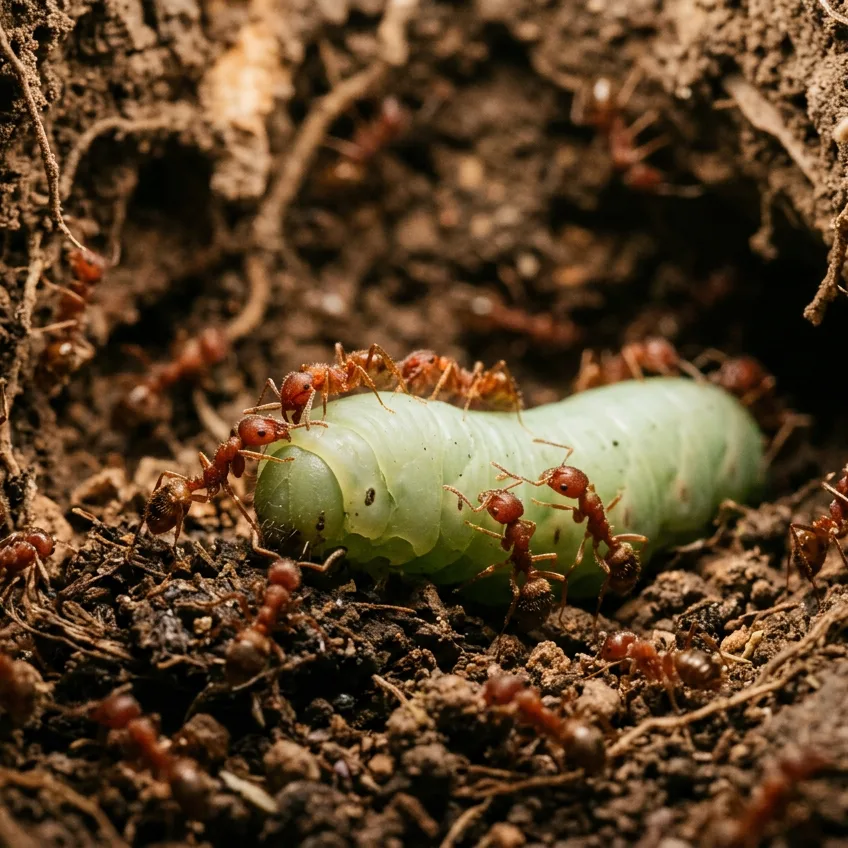
In European meadows, one of the most brazen evolutionary deceptions in the animal kingdom unfolds: the parasitic strategy of the Alcon blue butterfly (Phengaris alcon). After emerging from its egg on a flower, the caterpillar drops to the ground to begin a meticulously calculated biological charade.
On the ground, the caterpillar secretes a cocktail of cuticular hydrocarbons that precisely clones the scent of ant larvae from the genus Myrmica. When worker ants encounter it, they believe they have found one of their lost young and devotedly carry it into the underground heart of the anthill.
However, the true audacity of this insect was documented in 2009 by entomologists from the University of Oxford:
- The acoustic hack: The caterpillar does not stop at chemical mimicry; it has a ridge on its abdomen that it rubs rhythmically to produce a vibrational pulse inaudible to the human ear, but which replicates with astonishing precision the stridulations or 'song' of the queen of the anthill herself.
- Royal privileges: This sound grants the impostor the highest rank in the hierarchy. Workers offer it regurgitated food directly into its mouth before feeding their own larvae.
- Sacrifice of the colony: During periods of drought or scarcity, the ants go as far as sacrificing and devouring their own biological sisters to keep the giant caterpillar fed. During an invasion, workers rescue the intruder with greater urgency than their legitimate queen.
After devouring the colony's resources for nearly a year, the caterpillar pupates in secret. Upon emerging as an adult butterfly, it loses its chemical camouflage and must flee in a hurry before the bewildered workers discover the greatest scam of their lives.
Source: Science (Thomas et al., 2009 - 'Acoustic Mimicry in a Parasitic Butterfly')