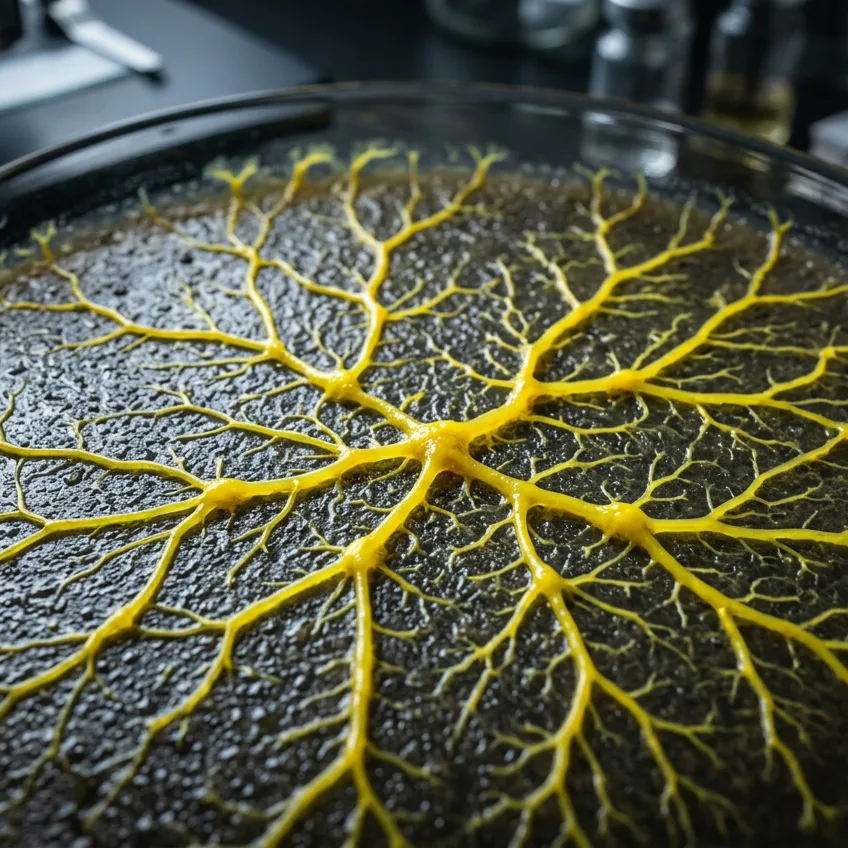
At first glance, Physarum polycephalum looks like a simple bright yellow slimy blob on fallen logs. However, this organism—a plasmodial slime mold formed by a single giant cell with millions of nuclei—harbors one of the most astonishing forms of decentralized biological intelligence on the planet, all without possessing a single neuron.
In 2010, a team of scientists led by Toshiyuki Nakagaki at Hokkaido University placed small oat flakes on a dish simulating the geographic location of Tokyo and 36 surrounding train stations. The mold began by spreading into a chaotic network, but in just 26 hours, it pruned redundant branches and reinforced the most efficient transport channels. The end result was a structure of protoplasmic veins nearly identical to Tokyo's metropolitan railway system, optimizing energy consumption and fault tolerance with the same precision as human engineers.
This living being achieves such feats thanks to the physics of its internal fluids:
- Physical memory: The oscillatory flow of its cytoplasm widens routes toward food and atrophies sterile pathways, storing spatial memory in the very architecture of its body.
- Mathematical optimization: It can navigate complex mazes by spontaneously selecting the shortest path between two food sources.
Able to anticipate periodic environmental changes and learn through habituation, Physarum polycephalum challenges traditional boundaries of cognition, inspiring new computer algorithms and bio-inspired telecommunications networks.
Source: Science (Tero et al., 2010: 'Rules for Biologically Inspired Adaptive Network Design')



