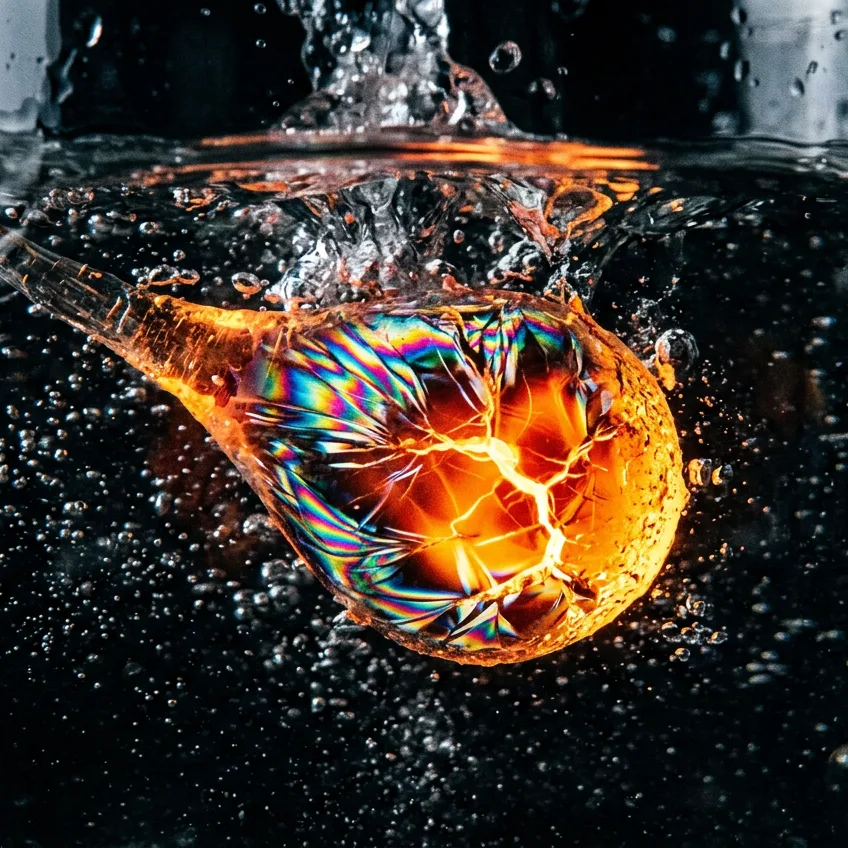
In 1660, Prince Rupert of the Palatinate astonished the Royal Society of London with tiny glass tears. The behavior of these pieces defied all apparent logic: their rounded bulb withstood hammer strikes and even bullet shots without breaking, but if the tip of its fragile tail was snapped, the entire drop disintegrated explosively into a cloud of microscopic powder.
The key to this phenomenon lies in materials physics and extreme thermal tempering:
- Differential cooling: They are formed by dropping molten glass directly into cold water. The outer surface solidifies immediately, while the interior remains molten for longer.
- Colossal internal stresses: As the inner core slowly cools and contracts, it pulls the outer shell inward. This creates compressive surface stresses of up to 700 megapascals (about 7,000 times atmospheric pressure), shielding the head against any fracture.
- Supersonic fracture wave: When the thin tail is snapped, the immense elastic tension accumulated inside is released. The crack propagates through the glass at over 1,650 meters per second (almost 6,000 km/h), pulverizing the entire structure in milliseconds.
This physical principle, which fascinated scientists like Robert Hooke nearly four centuries ago, is the direct foundation of tempered safety glass that protects vehicle windshields and modern electronic device screens today.
Source: Purdue University / Journal of Applied Physics