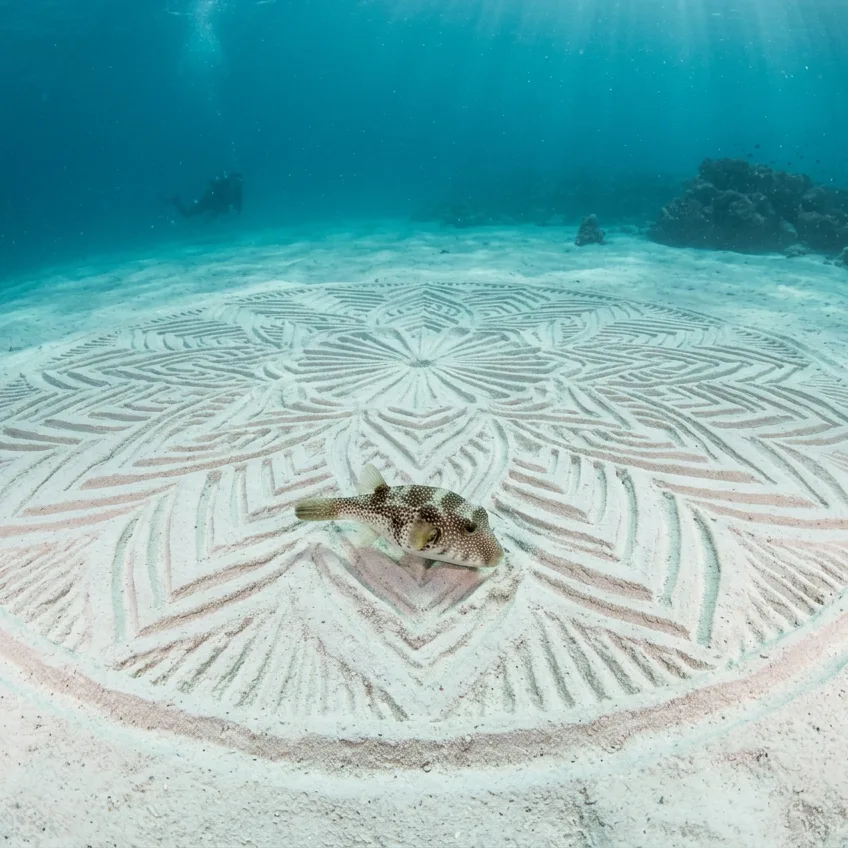
On the sandy seabeds of the Ryukyu Islands in Japan, divers observed mysterious geometric circles etched into the seabed at a depth of thirty meters for almost two decades. Their perfection and complexity recalled the famous crop circles, until in 2014 biologists discovered the unusual author: a tiny pufferfish twelve centimeters in length named Torquigener albomaculosus.
The male of this species undertakes one of the most astonishing bioengineering feats in the animal kingdom:
- Colossal effort: To erect a structure two meters in diameter (about twenty times its body size), the fish swims tirelessly for seven to nine days without resting, plowing the sand using only its fins and belly.
- Precision hydrodynamics: The sculpture is not merely decorative. The radial ridges and valleys channel ocean currents toward the center, reducing water velocity by up to 25% and gathering fine sand so the eggs are not swept away by tides.
- Selective adornments: Once the structure is completed, the fish collects fragments of broken shells and corals to crown the outer mounds.
When a female inspects the construction and spawns in the protected core, the male fertilizes the eggs and takes on parental care. Once the young hatch, the currents destroy the sculpture and the fish leaves the site, ready to sculpt a new mandala from scratch for its next courtship.
Source: Nature Scientific Reports (Kawase, Okata & Ito, 2013: 'Role of huge geometric circular structures in the reproduction of a marine pufferfish')