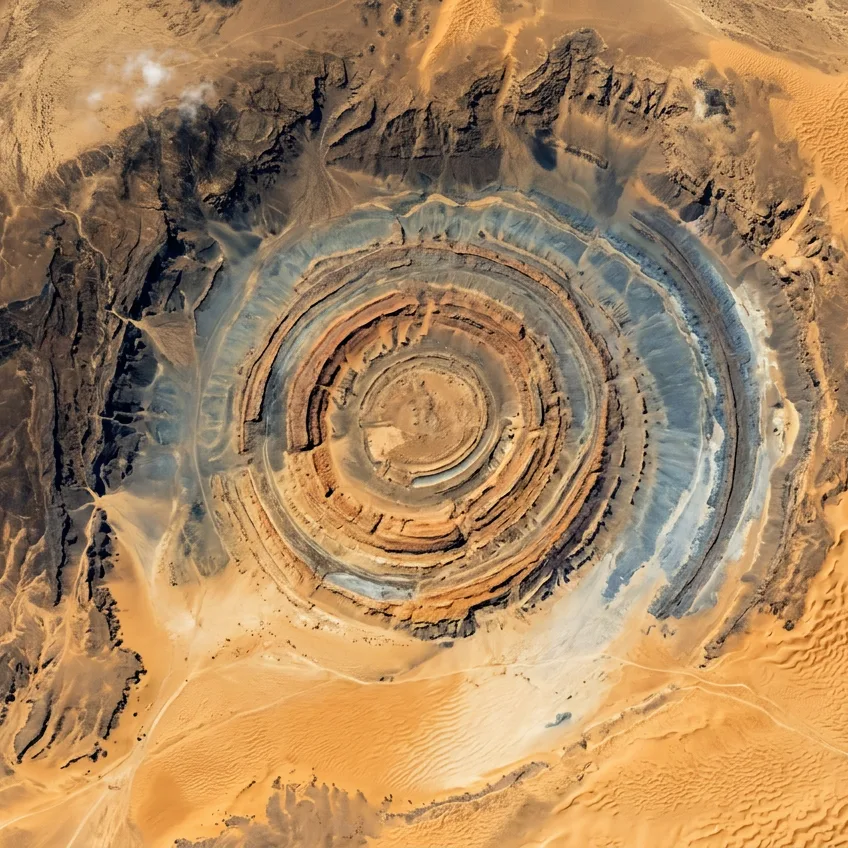
In the middle of the Mauritanian desert lies a nearly perfect circular formation over 40 kilometers in diameter, popularly known as the Richat Structure or the "Eye of the Sahara." From the ground, it goes almost unnoticed because of its massive scale, but from Earth's orbit it is so striking that astronauts on NASA's Gemini and Apollo missions regularly used it as a visual landmark for orientation.
For much of the 20th century, the scientific community theorized that it was an astrobleme: the scar left by the catastrophic impact of an ancient meteorite. Its annular symmetry and concentric rings matched the typical morphology of an eroded crater. However, field expeditions and comprehensive petrographic analyses ruled out this hypothesis: the rock showed no traces of shocked quartz, shatter cones, or any of the mineral alterations produced by extreme pressures of extraterrestrial origin.
The true origin of Richat is a masterpiece of magmatism and differential erosion over eons:
- Magmatic updoming: Around 100 million years ago, coinciding with the breakup of the supercontinent Pangea in the Cretaceous, an intrusion of magma pushed sedimentary rock layers upward, creating a gigantic vaulted geological dome.
- Hydrothermal collapse: The subsurface circulation of burning fluids altered and dissolved the structure's core, promoting its subsequent central karstic subsidence.
- Erosional sculpting: Wind and scarce fossil waters gradually dismantled the softer layers of limestone and shale, leaving behind the imposing circular ridges of quartzite, which are much harder and more resistant.
Far from being the reminder of a cosmic impact, the Eye of the Sahara is a monumental stratigraphic window into the planet's interior that took more than a hundred million years to sculpt.
Source: Geological Society of America (GSA) Bulletin